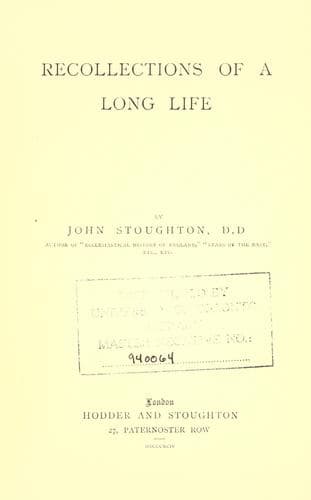
Clergy -- England -- Biography; Stoughton, John, 1807-1897
I first met him at Norwich where we took part in a Bible Meeting, and in
the course of my remarks I spoke of “sinking ecclesiastical differences”
on such an occasion. Dr. Magee, then Dean of Cork, made an amusing
reference to this, and repeated it with kindness and humour the next day,
as we travelled together by rail to London. We talked incessantly and at
the end he pressed me to visit him at Cork. Several years passed without
our meeting, and then at a funeral service in Westminster Abbey, he
kindly accosted me, saying, that as I had not been to see him at Cork, I
must go and see him at Peterborough, where, not long before, he had been
appointed bishop. Several visits followed, which I greatly enjoyed. My
impression of him as a brilliant talker, which I received on our journey
from Norwich to London, was now increased, and nothing could exceed his
hospitality and that of his amiable wife and daughters. We had several
drives; and one day we sat down together in a picturesque churchyard to
discuss ecclesiastical questions, where, as he said, the associations and
“_genius loci_” were on his side. I forget altogether what passed
between us, beyond a series of _pros_ and _cons_, and can only say that
we finished as we began—he a Churchman, I a Nonconformist, but both good
friends. Once when I was at Peterborough I heard him preach in the
Cathedral for the Bible Society, on the jubilee of the auxiliary, when he
took for his text two passages: “Is not this the carpenter’s son?” “The
Word was made flesh, and dwelt among us, and we beheld His glory, the
glory as of the only begotten of the Father, full of grace and truth.”
He admirably brought out the Divine and human sides of our blessed Lord’s
personality and then presented this as being in harmony with the Divine
and human elements in Holy Writ. As is well known, he did not use a MS.
in the pulpit; nor, as he told me, was he in the habit of _writing_ his
sermons beforehand. He seems to have had the gift of mental composition,
and also of expressing himself extemporaneously in felicitous diction and
with quiet ease. Nor was he at all verbose, as many fluent speakers are.
He could tell a story as few people can, sparkling with humour, and
distinct in point. I remember two he told of Dean Mansel. Taking a lady
round St. Paul’s, she paused to look at a figure of Neptune with his
_trident_, remarking that she was shocked at seeing in a church such
heathen mythology. “Why,” rejoined the Dean, “that looks more like
_Tridentine_ theology.” At a public dinner, after a toast to Reform—the
word on the paper had an _e_ at the end—“Reform,” the Dean remarked,
“often ended in an _émeute_.”
Public-domain text, read in full here on John Shaqi.
Reviews
Reviews
No reviews yet
Be the first to share your thoughts on this work.
Elsewhere in the archive
Join the Discussion
Join the discussion
Sign in to leave a comment or review.
Sign InorCreate an account