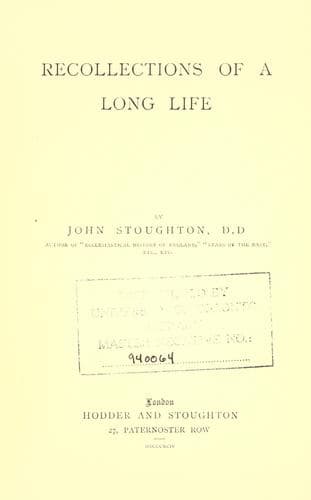
Clergy -- England -- Biography; Stoughton, John, 1807-1897
As I was preparing for my journey in Spain I met the Bishop at the
Athenæum, when he told me he was doing the same, and proposed we should
go together, adding that he could help me with his knowledge of Spanish.
I had heard him speak of his residence in Spain when he was a boy, and I
should have been delighted to fall in with his plan, but found it quite
impossible beforehand with regard to time. However, we agreed to inquire
after each other at consular offices, as we passed from place to place;
but I found I was always too late, or too soon. When I called at an
hotel in Madrid, where he had been staying, I learned he had just left
for the railway; and after our return, he told me his daughter saw me in
the street as they were hurrying to catch a train.
How many remarkable facts have been related within the last few years
respecting old English houses and estates!
During a visit to Lord Ebury, at Moor Park, he told me the mansion he
occupied had been in the hands of many distinguished families; and that
reminds one of what is said in the Eastern tale: “Call it not a palace
but a caravanserai.” It belonged to the Abbot of St. Albans; to Neville,
Archbishop of York; to Henry VII.; to De Vere, Earl of Oxford; to
Cardinal Wolsey; to Lucy, Countess of Bedford; to Sir John Franklin; to
the Earl of Ossory, who sold it to the Duke of Monmouth, whose Duchess
sold it to Mr. Styles, of South Sea Bubble notoriety, to be afterwards
purchased by Lord Anson. After changing owners again and again, it was
secured by the Marquis of Westminster for his son. Lord Ebury informed
me it had never remained in the same family more than two generations.
There runs a curious story of the Lady of the Earl of Monmouth, who
possessed the estate in the seventeenth century,—that her ladyship
protested against the intention of James I., to put his son Prince
Charles “into iron boots, to strengthen his joints and sinews”; for he
seemed to have been physically as a boy what he was, in some respects,
morally as a man—very _weak-kneed_.
In the course of my recollections, I have had much to say of foreign
tours, and also of journeys in different parts of England for various
religious purposes; but, in drawing my personal narrative to a close, I
am constrained to add a few lines, respecting visits to friends in my own
county, where I have enjoyed welcome rests amidst ministerial toils.
Public-domain text, read in full here on John Shaqi.
Reviews
Reviews
No reviews yet
Be the first to share your thoughts on this work.
Elsewhere in the archive
Join the Discussion
Join the discussion
Sign in to leave a comment or review.
Sign InorCreate an account