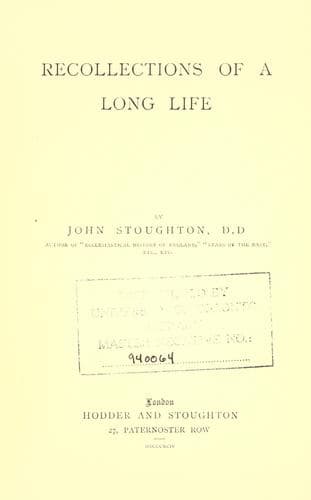
Clergy -- England -- Biography; Stoughton, John, 1807-1897
Hence, I gathered that the increase of Catholics in the neighbourhood did
not arise from local conversions; this explained what had been a matter
of wonder. The Monsignor was very sociable and communicative, and gave
much information about Romanism, its usages and dignitaries. He had a
great deal to say about the political relations of distinguished
Catholics at that time. How far all his reports were to be trusted I
cannot say.
Certainly there was much activity amongst Hammersmith Catholics. Within
a few doors of my house there was a sisterhood active in collecting
whatever they could of money, garments, and other benefits for the poor,
and on the edge of Brook Green rose a handsome church, in which special
revival services were held. I attended one of these, and heard a priest
make earnest religious appeals to careless sinners.
There was a nunnery not far off, and from the abbess, through the medium
of a relative, I received an invitation to witness the ceremony of taking
the veil. As a spectacle, there was something about it pathetic and
touching, but as an act of worship the whole struck me as altogether out
of harmony with primitive Christianity. The relative who conveyed to me
the invitation was the daughter of a Dissenting minister, a girl highly
imaginative and poetical, who made some little stir in earlier life by a
book entitled “From Oxford to Rome,” by “One that made the Journey.” She
told me of a complimentary note on the subject from a High Church
politician; and I found that she had been thrown a good deal in the way
of Oxford “perverts,” as they were called. She became a decided convert,
and related to me much of what she saw amongst her new friends. By her
severe penances she broke down her health until she died, but not in the
religion she had recently embraced. The faith of her childhood, in its
simplicity, returned in her last days. I do not know that she made a
formal renunciation of what she had lately embraced, but she desired no
priestly ministrations, and fell back upon her Bible, and the truths she
had accepted in former days. She joined in her father’s prayers by her
bedside, and so went home to rest for ever with her Saviour, whom she
loved amidst all her aberrations of controversial thought.
Soon after my resignation I paid a summer visit to my friend Mr. George
Moore, of Whitehall, Cumberland, the well-known merchant prince. There I
met Lord Justice Lush, his lady and daughter, Dr. Moffat, Canon
Battersby, and Mr. Smithies, the “Workman’s Friend.” One day we had
Bible readings in a baronial-looking hall; another day we had outdoor
recreations for the villagers, when a select party dined at the mansion.
In the evenings we were taken to places in the neighbourhood to attend
Bible meetings. On Sunday we went to church in the morning and to chapel
in the evening. Our host was in all his glory.
Public-domain text, read in full here on John Shaqi.
Reviews
Reviews
No reviews yet
Be the first to share your thoughts on this work.
Elsewhere in the archive
Join the Discussion
Join the discussion
Sign in to leave a comment or review.
Sign InorCreate an account