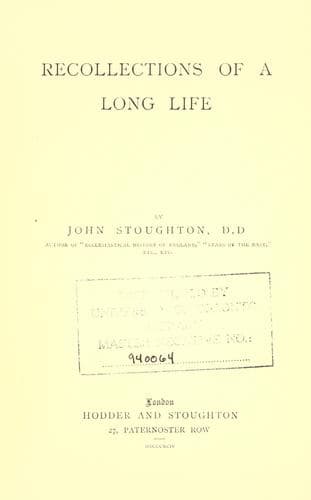
Clergy -- England -- Biography; Stoughton, John, 1807-1897
One spot, long years ago, where I was wont to seek recreation was
Letheringsett Hall, near Holt, in my native county, Norfolk. There still
lives Mr. Cozens-Hardy, whom I knew as a boy, about five years old, in
days when we worshipped in Calvert Street Chapel, Norwich. He married a
lady whom I recollect as a girl, and who was long the light of his
dwelling, well known to numerous guests. They hospitably entertained me
in many of my summer holidays, and drove me round the neighbourhood
called “The Garden of Norfolk.” Respecting his beloved wife, let me
quote words which I wrote for a short family memorial of her: “My last
two or three visits found her weak and frail, but yet a good deal of her
old buoyancy would come back as we sat chatting round the fire. She
seemed to have a quiet faith in the blessed Gospel, but with some shadows
of doubt and fear respecting herself. No bold, self-asserting
professions, as is the case with some, but a genuine sympathy in
reference to the fundamental truths of the Gospel, which form the
resting-place of all true believers. She seemed to know more of the
Valley of Humiliation than of the Land of Beulah; not often climbing the
Delectable Mountains, but by no means a prisoner in Doubting Castle.”
Her good husband has for many years been the main supporter of the
Methodist Society in Holt, and his son, the eminent Q.C., has been for
many years a member of the Congregational Church at Kensington. The
large-hearted Mr. Colman, M.P. for Norwich, married Mr. Cozens-Hardy’s
eldest daughter, and in their hospitable homes at Carrow and Corton I
have spent many a happy day.
I may add here that amongst delightful sojourns in English homes, I
gratefully reckon Stanley Park, the residence of Sir Samuel Marling; a
marine villa at Dawlish, belonging to Sir Thomas Lea, Bart., also his
home at Kidderminster; the beautiful Quinta on the Welsh border,
belonging to Colonel Barnes; and the marine residence of Miss Cheetham,
one of my interesting school-girls at Kensington.
During the later portion of my residence in Kensington, there was a
considerable increase of Roman Catholics residing in the neighbourhood.
When I first went to it, a small place of worship sufficed to meet their
wants, but before I left, a large church was built near the Vicarage, and
another in the high road, partly hidden by buildings in front. After the
formation of a Westminster Archiepiscopal see, the last-named edifice
became a pro-cathedral, where Cardinal Manning sometimes officiated. As
I did not hear of numerous conversions, in the neighbourhood, to the
Romish faith, I was curious to know whence the increase arose, and one
day I had a long conversation on the subject with Monsignor Capel. He
informed me that it was owing largely to an increase in the number of
priests who had come to reside in the place, and who attracted many
retired people who were desirous of opportunities for confession and
spiritual advice.
Public-domain text, read in full here on John Shaqi.
Reviews
Reviews
No reviews yet
Be the first to share your thoughts on this work.
Elsewhere in the archive
Join the Discussion
Join the discussion
Sign in to leave a comment or review.
Sign InorCreate an account