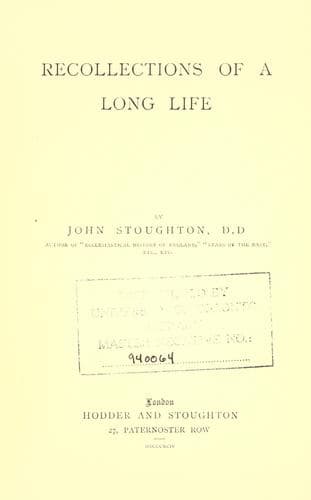
Clergy -- England -- Biography; Stoughton, John, 1807-1897
At a later period he took up peculiar views on prophecy, and on some
ecclesiastical points. Then he became wild and incoherent. I heard him
preach outside Coldbath Prison to a few bystanders, very differently from
what he had done in Hatton Garden. He seemed to have lost unction as
well as thoughtfulness and eloquence. On a cold winter morning, before
breakfast, several students and myself walked down to his new church in
Regent Square to witness “the gift of tongues,” which, amongst other
imaginations, he believed had been miraculously bestowed. The building
was dark, for the sun had not risen, and the mysterious gloom heightened
the effect of the exhibition which followed. First arose inarticulate
screams, then exclamations of “He is coming!” “He is co-m-i-ng!” drawn
out in marvellous quavers. What appeared to me inarticulate and
incomprehensible sounds, were regarded by him and many people as Divine
utterances. They deemed them the return of Pentecost—a gift of tongues.
At London Wall Church I saw him afterwards arraigned before the
presbytery for heretical opinions touching the Lord’s humanity. He
fought his battle manfully; and whatever people might think of his
sentiments, they could scarcely fail to be impressed with the sincerity
and earnestness of the man. The trial issued in his expulsion from
Regent Square—poor fellow! It is touching to think of his history;
popularity was his snare. It turned his head; yet, after all, he
sacrificed that very popularity to sincere convictions. His latest life
was an instance of martyrdom for conscience’ sake. Those who condemn his
opinions must honour the man.
Dr. Chalmers came to preach at Regent Square. After the benefit derived
from his printed sermons, I might well desire to hear his voice. The
pitch of excitement to which he wrought himself up surpassed everything
of the kind I ever witnessed. His vehemence was terrific, yet all seemed
natural. He was John Knox over again—John Knox in manner, more than John
Knox in thought and eloquence of expression. He moved on “hinges,” as
Robert Hall said, or rather, “like a cloud, that moveth altogether, if it
move at all.” The fact is, he felt what he was saying. It went down to
the depths of his own soul, and hence it reached the souls of others.
The crowd in the church was immense, numbers standing all the time; yet
it was curious to learn that the sermon was already in print—in print, I
believe, years before. He often redelivered his discourses, even after
publication; and Dr. Wardlaw of Glasgow told me his distinguished
neighbour informed him, that he tried to lessen the crowds at church by
announcing that next time he meant to deliver what they had heard
already. “Yet,” with a childlike simplicity the old man added, “they
come in still larger numbers than before!” Not many preachers are
troubled in that way.
Public-domain text, read in full here on John Shaqi.
Reviews
Reviews
No reviews yet
Be the first to share your thoughts on this work.
Join the Discussion
Join the discussion
Sign in to leave a comment or review.
Sign InorCreate an account