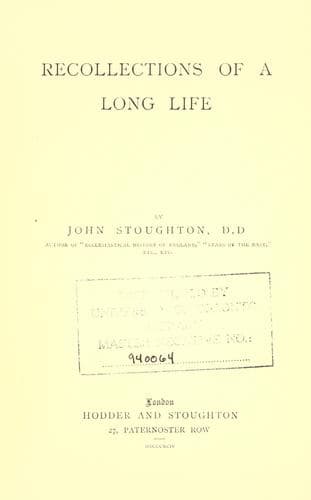
Clergy -- England -- Biography; Stoughton, John, 1807-1897
Some time afterwards, I listened to Lord Brougham in the same hall on the
same subject. He was then past his best days, but flashes of oratory,
full of satire and invective against the party he had left, burst forth
in a long speech, which, as chairman, he delivered in the middle of the
proceedings, to the interruption of previous arrangements. It was, I
suppose, by no means equal to his earlier efforts, but enough remained of
thunder and lightning to remind one of his eulogised resemblance to
Demosthenes.
CHAPTER III
1832–1837
WHEN I first saw Windsor in the winter of 1830–31 how different the town
appeared from what it did afterwards! All about Thames Street and Castle
Hill was crowded with old houses and shops on both sides of the way, and
the walls bounding Lower Ward were hidden from view, except where the
Clock Tower, which stood in advance, looked down upon the passers-by. A
large plain brick mansion, called the Queen’s Lodge, long since removed,
occupied the right hand of the road leading to York and Lancaster Gate,
while old-fashioned tenements lined the approach to the royal precincts.
On the night of my first arrival patches of snow covered the roofs, and
dotted the pediments of doors and windows; over Henry VIII.’s gateway
hung a gorgeous hatchment in memory of George IV., who had not long
before left this life. It was slow travelling from London to Windsor in
those days, especially when the waters were out, and the roads were
heavy, and thick fogs rendered the leaders invisible to the coachman;
whilst deep ruts clogged the wheels and now and then an icy flood came up
to the axles. In the town I heard a great deal about “Windsor of the
olden time,” when highway robbers were rife, and gentlemen who took to
the road would lie in wait under cover of a plantation, and, galloping
over a field, stop the traveller and lighten him of his purse. According
to one informant, a tradesman in High Street, at the latter part of the
eighteenth century, kept a swift-trotting nag, which he mounted after
dark to do a little business on the road, and then returned richer than
he went. People at that time, as I heard some of them say, did not think
of riding or driving over Hounslow Heath alone; but, when approaching
that ill-famed spot where gibbets lingered by the roadside, were careful
to wait till a number was formed able to defend themselves against the
attack of thieves. The sobriety of many inhabitants in the royal borough
did not stand high, and at mayors’ feasts the guests did not think they
sufficiently honoured the hospitalities of the evening, unless they drank
so much as made it difficult for them to find their way home.
Public-domain text, read in full here on John Shaqi.
Reviews
Reviews
No reviews yet
Be the first to share your thoughts on this work.
Join the Discussion
Join the discussion
Sign in to leave a comment or review.
Sign InorCreate an account