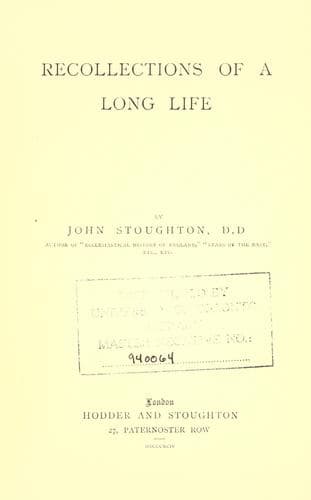
Clergy -- England -- Biography; Stoughton, John, 1807-1897
lie would fain have induced me to enter the Establishment, but though he
did not succeed in that respect, he ever treated me with a brotherly
regard, which I sincerely reciprocated. Before he embarked for his
distant field of labour he wrote a farewell note in which he said: “On
the few points in which we differ, I thank God we have been enabled to
dwell, often at some length, without one particle of that acrimony which
often discredits controversy, and proves it to proceed rather from human
passions than from zeal for the truth of God. I cannot recollect,
throughout all our intercourse, one single word which can be considered
as a breach of charity between us. For this I am especially thankful,
that when I go to offer up my gift upon far distant altars, I shall have
left no brother at home, with whom I ought first to have been
reconciled.”
I had a ticket for St. George’s Chapel when William IV. was interred.
The interior of the building was dark, except as illumined by torches in
the hands of soldiers who lined the nave, and by numerous lights within
the choir. When the procession drew up about nine o’clock, at the south
entrance, the blaze of outside torches was seen through the stained
windows; then the appearance of heralds in their tabards followed: next
the slow march of mourners close to the coffin, the Duke of Sussex being
most conspicuous; afterwards a funeral dirge echoed from the fretted
roof. The silence was further broken by the Burial Service and the
repetition of royal titles. “Sic transit gloria mundi” came last, and
left an ineffaceable impression.
I was further favoured with a ticket to see the coronation in Westminster
Abbey. When the procession entered the nave, officers of state and
foreign ambassadors appeared in rich costume. Diamond-decked coats and
rich mantles made a grand show, yet they chiefly served to set off the
simple dignity of the queen in her early girlhood, whilst a spell of
loyalty touched spectators looking down from lofty galleries. The
coronation shout of “God save the Queen” needed to be heard that it might
be fully understood. Afterwards, a stream of dignified personages, with
mantles and coronets, issued from the choir and covered the nave with a
tesselated pattern of rich colours.
To the coronation succeeded the royal marriage, honoured at Windsor by
extraordinary festivities; and at night the cortége of the bride and
bridegroom, on their way to the castle through decorated and illuminated
streets, evoked a rapturous welcome from assembled thousands. But what
above all other incidents of that occasion lives in my memory at the
present moment is the sudden view which I caught a day or two afterwards
of the wedded pair in a pony carriage, driven by the bridegroom as his
bride nestled beside him, under his wing, with simplicity which gave
exquisite finish to the chief pictures which passed before me that
summer.
Public-domain text, read in full here on John Shaqi.
Reviews
Reviews
No reviews yet
Be the first to share your thoughts on this work.
Join the Discussion
Join the discussion
Sign in to leave a comment or review.
Sign InorCreate an account