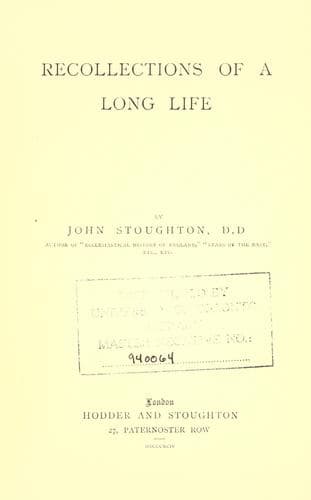
Clergy -- England -- Biography; Stoughton, John, 1807-1897
Going back a few years, let me notice “Eton Montem,” then witnessed in
all its splendour. Approaches to the college were guarded by boys in
fancy costumes: coloured velvet coats, yellow boots, caps decorated with
graceful plumes, appeared on the scene. The youngsters levied a tax on
all comers, calling it “_salt_,” which they deposited in bags suspended
from their necks. As royal carriages swept across Windsor bridge,
picturesque sentinels received handsome donations from royal hands. The
gifts, together with a large number of others, formed a fund for the
captain of the school to defray his expenses at Cambridge, whither he was
sent in prospect of a fellowship. The procession of boys to Salt Hill,
where the captain waved a flag after a prescribed fashion, excited
immense interest, and was witnessed by multitudes. The sight in the
college gardens as the day closed, afforded perhaps the best of the
pageant, for these lads, attired in Turkish, Greek, Italian, and other
showy garbs, mixed with their friends so as to form a picture of animated
life, with old trees and old buildings for a background.
I had not been long in the town before I became intimately connected with
the British and Foreign Bible Society, which laid a strong hold on my
affections as a boy, and to which I firmly adhered, after I became a man.
Our auxiliary was a flourishing one. Some relatives of Lord Bexley,
president of the parent society, lived in our neighbourhood, and used to
come over to our annual gatherings in the Town Hall. One of them, the
Rev. Mr. Neal, of Taplow, was a constant visitor. He typified a class of
men now almost extinct. They loved the Establishment, and, judging of it
by its formularies, identified it with the cause of evangelical religion.
They knew much less of Anglo-Catholic theology than of Puritanical works.
Owen and Baxter occupied a conspicuous place on their literary shelves,
by the side of Latimer and Calvin. The Evangelicals were nevertheless
faithful to their own ecclesiastical order, preferring episcopacy to any
other form of government. Not on social or literary grounds had they
sympathy with Dissenters, or from what is now recognised as “breadth of
opinion,” but they cultivated union, on purely evangelical grounds.
Public-domain text, read in full here on John Shaqi.
Reviews
Reviews
No reviews yet
Be the first to share your thoughts on this work.
Join the Discussion
Join the discussion
Sign in to leave a comment or review.
Sign InorCreate an account