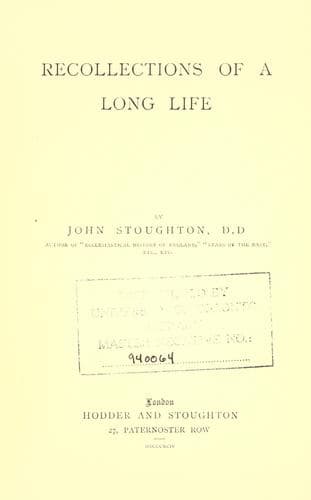
Clergy -- England -- Biography; Stoughton, John, 1807-1897
Revivalism at the period now referred to, attracted attention in England,
in part owing to the circulation of American books, and the preaching of
American divines. A great awakening occurred at Reading, Henley,
Maidenhead, and Windsor. Streams of people might be seen on dark winter
mornings, lantern in hand, on their way to the place of prayer. Chapels
were thronged, ministers were in full sympathy with each other; all
worked with a will. Looking back on the whole, I believe genuine good
was done; yet in some instances the effect was transient. Conversion was
insisted upon, and peace with God through Jesus Christ was offered; but
whether moral improvement in the details of human life was proportionally
emphasised, and practically carried out, I am not prepared to say.
Certainly, appeals respecting holiness in general were not wanting.
Rightly to adjust the balance, so as to guard against self-righteousness
on one hand, and the neglect of personal responsibility on the other,
requires vast wisdom. To induce people to look at themselves and to
Christ also, cannot be accomplished without thought and discrimination in
promiscuous gatherings. Whatever might be defects in the movement,
assuredly they did not come from artificial arrangements. No one can be
said to have “got up the thing.”
At all times in the course of our ministry “cases of conscience” occur.
One in particular I may mention. I was once sent for to visit a dying
person. The home, the people, the surroundings, excited revulsion, as
well as a determination to improve a strange opportunity. I found a
young woman on her deathbed, and another sitting by, who used phraseology
indicative of evangelical sentiment. She offered to leave the room that
the patient might unburthen her mind to me. It was obvious some secret
of guilt lay on the sufferer’s conscience. I had no wish to be a father
confessor, and pointed her to the _only One_ who can pardon sin. At last
the dying creature uttered a piercing exclamation, which seemed to me an
acknowledgment of sin. What the secret was she did not disclose.
Presently she entered “the silent land.” When I called again, I
intimated to her attendant my surprise at what she had said, for I could
not doubt that she was leading an immoral life. She frankly confessed
she had fallen into vice, after expressing a belief that she had been
converted, and _had_ been a “child of God.” The incident was affecting,
instructive, and admonitory.
Public-domain text, read in full here on John Shaqi.
Reviews
Reviews
No reviews yet
Be the first to share your thoughts on this work.
Join the Discussion
Join the discussion
Sign in to leave a comment or review.
Sign InorCreate an account