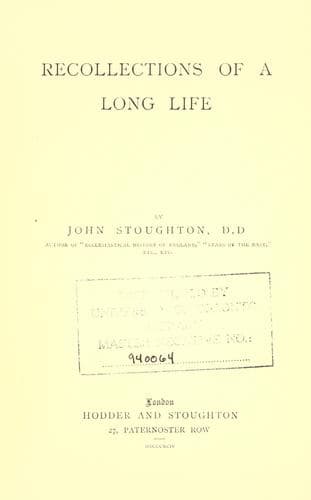
Clergy -- England -- Biography; Stoughton, John, 1807-1897
My father died in my fifth year. Of him I have but a faint recollection.
My grandfather, at a distance now of seventy-five years, visibly stands
before me—a tall old gentleman with flaxen wig, large spectacles, a long,
blue, bright-buttoned coat, and big buckled shoes. He was Master of
Bethel Hospital, an institution for the insane, in my native city; and,
as I spent much time with him for a year before his death, I saw and
heard a good deal of the patients under his care. “Master,” said one of
them, “I want to propose a toast—may the devil never go abroad or receive
visitors at home.” “What brought you here?” somebody asked an inmate.
“The loss of what you never had, or you would not ask such a question,”
was the prompt reply. A man who fancied himself King of England drew on
his cell wall pictures of ships which he called his fleet, and would
never speak unless he was addressed as “Your Majesty.” I once narrowly
escaped severe injury from a woman, who seized me as her child and
squeezed me so hard, that no violence could induce her to relax her
grasp; but gentle words, and a promise that I should be taken care of,
secured my release. Alternate severity and indulgence, at that time, in
the treatment of patients led to a sad tragedy in the case of my
grandfather, who was killed by a man employed as gardener. He was
thought to be harmless, and used to mow the lawn. One morning he drew
the scythe across his master’s body and nearly cut him in two.
My mother had a dream the night before, and saw in it her father lying on
a bed, pale as ashes, which she interpreted as meaning something terrible
would happen to him. When, at breakfast time, she was told by a
gentleman of what had occurred, she coupled it with what she had seen in
her sleep.
We were living at the time in a very old house with diamond-paned
windows, a brick-paved entrance hall, and some rambling passages. I well
remember the little bedroom in which I slept. There resided with us an
old lady, widow of a Norwich gentleman, who had been a friend of the
famous George Whitefield. She used to tell anecdotes of the popular
preacher—how he called himself Dr. Squintum, and, when supping off
cowheel, a dish he liked, would say, he wondered what people would think
of his being so employed.
Public-domain text, read in full here on John Shaqi.
Reviews
Reviews
No reviews yet
Be the first to share your thoughts on this work.
Join the Discussion
Join the discussion
Sign in to leave a comment or review.
Sign InorCreate an account