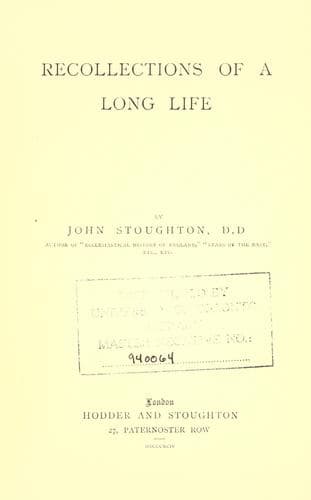
Clergy -- England -- Biography; Stoughton, John, 1807-1897
In further illustration of the Dean’s ingenuity when turning Scripture to
account in the improvement of events, I may here repeat what he once
related to me. He happened on a Saturday to be preparing a sermon for
the Abbey, on some occasion when he was to plead for _two_ objects, and
had chosen for his text Gen. xxvii. 38—“And Esau said unto his father,
hast thou but one blessing my father? Bless me, even me also, O my
father.” As the Dean was writing his discourse, some one stepped in and
told him, the American President, General Grant, intended to be at the
Abbey the next day, and suggested that it would be gratifying to
Americans if some allusion was made to the incident. Immediately it was
turned to account by the Dean in this way—that God had many blessings
which He distributed amongst his children; that bounty to one did not
mean denial to another; that Great Britain, for instance, had been
blessed, but God had rich benefactions for America as well.
For years I felt an earnest desire to visit the East, and thus to become
personally acquainted with Bible lands. A meeting was held in 1865 to
present me with a purse of £400, and a pledge that expenses incurred
through my absence from Kensington should be met, without any pecuniary
responsibilities on my part. The friends who accompanied me were Dr.
Allon, of Union Chapel, Islington, Dr. Spence, of the Poultry Chapel,
London, Dr. Bright, minister of the Independent Chapel, Dorking, and two
young lay friends—Stanley Kemp-Welch and Thomas Wilson. The Dean of
Westminster gave me introductions to people he knew in Palestine, and
afforded valuable assistance in other ways.
We started in February 1865. I kept a journal and sent home long
letters. We visited Alexandria and Cairo, and then proceeded through the
desert of Sinai to the monastery at the foot of Jebel Mousa. Turning
north, we made our way to Gaza, thence to Ramleh, and so onwards to
Jerusalem. The members of our little party, as we approached the city on
horseback, rode at a considerable distance from each other. I knew that
we should cross some ridges, before we caught sight of the city, and I
happened to be in the rear of my fellow-travellers. I watched the
foremost of them till I saw him pull up his horse, pause awhile, then
take off his hat. I knew what that meant, and the feelings awakened I
can never forget while I live. I eagerly, and I may say reverently,
followed the foremost horseman, and as soon as I caught sight of the
walls and the gate, I am not ashamed to say, my eyes were full of tears.
Public-domain text, read in full here on John Shaqi.
Reviews
Reviews
No reviews yet
Be the first to share your thoughts on this work.
Elsewhere in the archive
Join the Discussion
Join the discussion
Sign in to leave a comment or review.
Sign InorCreate an account