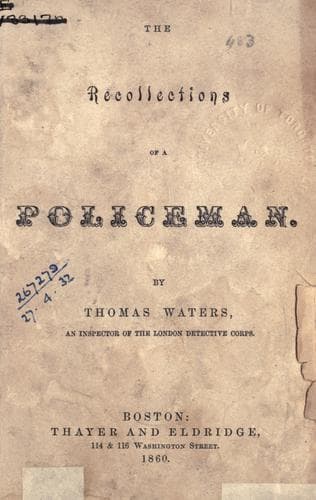
Detective and mystery stories, English; Police -- Fiction; Short stories
"It was impossible to make out any case in his behalf, and on his trial
he pleaded guilty. How or when he got the means I don't know; but while
he was awaiting his sentence, he poisoned himself in Newgate."
We inquired of this officer, on the conclusion of the foregoing
anecdote, whether the time appeared long, or short, when he lay in that
constrained position under the sofa?
"'Why, you see, Sir,' he replied, 'if he hadn't come in, the first time,
and I had not been quite sure he was the thief, and would return, the
time would have seemed long. But, as it was, I being dead-certain of my
man, the time seemed pretty short.'"
Part XIV.
THE MARTYRS OF CHANCERY.
In Lambeth Marsh stands a building better known than honored. The
wealthy merchant knows it as the place where an unfortunate friend, who
made that ruinous speculation during the recent sugar-panic, is now a
denizen; the man-about-town knows it as a spot to which several of his
friends have been driven, at full gallop, by fleet race-horses and dear
dog-carts; the lawyer knows it as the "last scene of all," the
catastrophe of a large proportion of law-suits; the father knows it as a
bug-bear wherewith to warn his scapegrace spendthrift son; but the uncle
knows it better as the place whence nephews date protestations of reform
and piteous appeals, "this once," for bail. Few, indeed, are there who
has not heard of the Queen's Prison, or, as it is more briefly and
emphatically termed, "The Bench!"
Awful sound! What visions of folly and roguery, of sloth and seediness,
of ruin and recklessness, are conjured up to the imagination in these
two words! It is the "Hades" of commerce--the "Inferno" of fortune.
Within its grim walls--surmounted by a chevaux de frise, classically
termed "Lord Ellenborough's teeth"--dwell at this moment members of
almost every class of society. Debt--the grim incubus riding on the
shoulders of his victim, like the hideous old man in the Eastern
fable--has here his captives safely under lock and key, and within
fifty-feet walls. The church, the army, the navy, the bar, the press,
the turf, the trade of England, have each and all their representatives
in this "house." Every grade, from the ruined man of fortune, to the
petty tradesman who has been undone by giving credit to others still
poorer than himself, sends its members to this Bankrupts' Parliament.
Nineteen-twentieths in this Royal House of Detention owe their
misfortunes directly or indirectly to themselves; and, for them, every
free and prosperous man has his cut-and-dry moral, or scrap of pity, or
screed of advice; but there is a proportion of prisoners--happily a
small one--within those huge brick boundaries, who have committed no
crime, broken no law, infringed no commandment. They are the victims of
a system which has been bequeathed to us from the dark days of the "Star
Chambers" and "Courts of High Commission"--we mean the Martyrs of
Chancery.
Public-domain text, read in full here on John Shaqi.
Reviews
Reviews
No reviews yet
Be the first to share your thoughts on this work.
Elsewhere in the archive
Join the Discussion
Join the discussion
Sign in to leave a comment or review.
Sign InorCreate an account