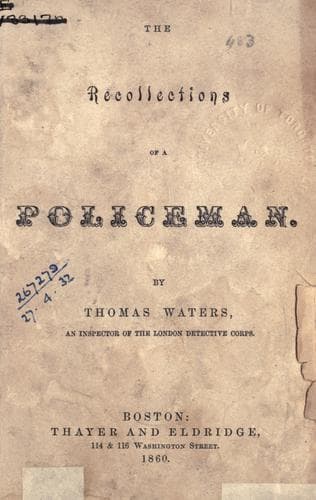
Detective and mystery stories, English; Police -- Fiction; Short stories
These unhappy persons were formerly confined in the Fleet Prison, but on
the demolition of that edifice, were transferred to the Queen's Bench.
Unlike prisoners of any other denomination, they are frequently ignorant
of the cause of their imprisonment, and more frequently still, are
unable to obtain their liberation by any acts or concessions of their
own. There is no act of which they are permitted to take the benefit--no
door left open for them in the Court of Bankruptcy. A Chancery prisoner
is, in fact, a far more hopeless mortal than a convict sentenced to
transportation; for the latter knows that at the expiration of a certain
period, he will, in any event, be a free man. The Chancery prisoner has
no such certainty; he may, and he frequently does, waste a life-time in
the walls of a jail, whither he was sent in innocence--because,
perchance, he had the ill-luck to be one of the next of kin of some
testator who made a will which no one could comprehend, or the heir of
some intestate who made none. Any other party interested in the estate
commences a Chancery suit, which he must defend or be committed to
prison for "contempt." A prison is his portion, whatever he does; for,
if he answers the bill filed against him, and cannot pay the costs, he
is also clapped in jail for "contempt." Thus, what in ordinary life is
but an irrepressible expression of opinion or a small discourtesy, is,
"in Equity," a high crime, punishable with imprisonment--sometimes
perpetual. Whoever is pronounced guilty of contempt in a Chancery sense,
is taken from his family, his profession, or his trade, (perhaps his
sole means of livelihood,) and consigned to a jail where he must starve,
or live on a miserable pittance of three shillings and sixpence a week,
charitably doled out to him from the county rate.
Disobedience of an order of the Court of Chancery--though that order may
command you to pay more money than you ever had, or to hand over
property which is not yours and was never in your possession--is
contempt of court. No matter how great soever your natural reverence for
the time-honored institutions of your native land--no matter, though you
regard the Lord High Chancellor of Great Britain as the most wonderful
man upon earth, and his court as the purest fount of Justice, where she
sits weighing out justice with a pair of Oertling's balances, you may
yet be pronounced to have been guilty of "contempt." For this there is
no pardon. You are in the catalogue of the doomed, and are doomed
accordingly.
A popular fallacy spreads a notion that no one need "go into Chancery,"
unless he pleases. Nothing but an utter and happy innocence of the
bitter irony of "Equity" proceedings keeps such an idea current. Men
have been imprisoned for many years, some for a life-time, on account of
Chancery proceedings, of the very existence of which they were almost in
ignorance before they "somehow or other were found in contempt."
Public-domain text, read in full here on John Shaqi.
Reviews
Reviews
No reviews yet
Be the first to share your thoughts on this work.
Elsewhere in the archive
Join the Discussion
Join the discussion
Sign in to leave a comment or review.
Sign InorCreate an account