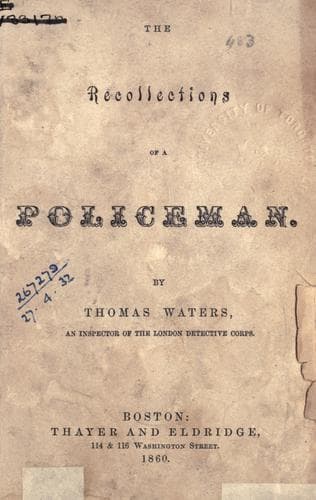
Detective and mystery stories, English; Police -- Fiction; Short stories
The most litigious fellow I ever knew, was a Welshman, named Bones. He
had got possession, by some means, of a bit of waste ground behind a
public-house in Hogwash Street. Adjoining this land was a yard belonging
to the parish of St. Jeremiah, which the Parish Trustees were fencing in
with a wall. Bones alleged that one corner of their wall was advanced
about ten inches on his ground, and as they declined to remove it back,
he kicked down the brick-work before the mortar was dry. The Trustees
having satisfied themselves that they were not only within their
boundary, but that they had left Bones some feet of the parish land to
boot, built up the wall again. Bones kicked it down again.
The Trustees put it up a third time, under the protection of a
policeman. The inexorable Bones, in spite of the awful presence of this
functionary, not only kicked down the wall again, but kicked the
brick-layers into the bargain. This was too much, and Bones was marched
off to Guildhall for assaulting the brick-layers. The magistrate rather
pooh-poohed the complaint, but bound over Bones to keep the peace. The
_causa belli_, the wall, was re-edified a fourth time; but when the
Trustees revisited the place next morning, it was again in ruins! While
they were in consultation upon this last insult, they were politely
waited on by an attorney's clerk, who served them all with "writs" in an
action of trespass, at the suit of Bones, for encroaching on his land.
Thus war was declared about a piece of dirty land literally not so big
as a door-step, and the whole fee-simple of which would not sell for a
shilling. The Trustees, however, thought they ought not to give up the
rights of the parish to the obstinacy of a perverse fellow, like Bones,
and resolved to indict Bones for assaulting the workmen. Accordingly,
the action and the indictment went on together.
The action was tried first, and as the evidence clearly showed the
Trustees had kept within their own boundary, they got the verdict. Bones
moved for a new trial; that failed. The Trustees now thought they would
let the matter rest, as it had cost the parish about one hundred and
fifty pounds, and they supposed Bones had had enough of it. But they had
mistaken their man. He brought a writ of error in the action, which
carried the cause into the Exchequer Court, and tied it up nearly two
years, and in the meantime he forced them _nolens volens_ to try the
indictment. When the trial came on, the judge said, that as the whole
question had been decided in the action, there was no occasion for any
further proceedings, and therefore the Defendant had better be
acquitted, and so make an end of it.
Public-domain text, read in full here on John Shaqi.
Reviews
Reviews
No reviews yet
Be the first to share your thoughts on this work.
Elsewhere in the archive
Join the Discussion
Join the discussion
Sign in to leave a comment or review.
Sign InorCreate an account