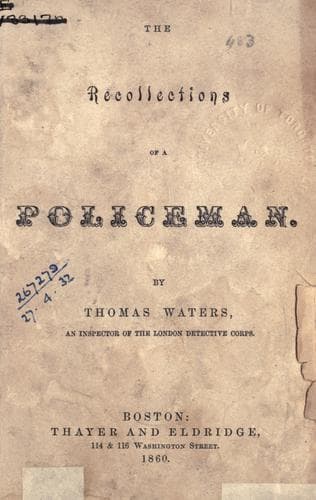
Detective and mystery stories, English; Police -- Fiction; Short stories
Accordingly, Bones was acquitted; and the very next thing Bones did was
to sue the Trustees in a new action, for maliciously instituting the
indictment against him without reasonable cause! The new action went on
to trial; and it being proved that one of the Trustees had been
overheard to say that they would punish him; this was taken as evidence
of malice, and Bones got a verdict for forty shillings damages besides
all the costs. Elated with this victory, Bones pushed on his old action
in the Exchequer Chamber to a hearing, but the Court affirmed the
judgment against him, without hearing the Trustees' counsel.
The Trustees were now sick of the very name of Bones, which had become a
sort of bugbear, so that if a Trustee met a friend in the street he
would be greeted with an inquiry after the health of his friend, Mr.
Bones. They would have gladly let the whole matter drop into oblivion,
but Jupiter and Bones had determined otherwise; for the indomitable
Briton brought a Writ of Error in the House of Lords, on the judgment of
the Exchequer Chamber. The unhappy Trustees had caught a Tartar, and
follow him into the Lords they must. Accordingly, after another year or
two's delay, the case came on in the Lords. Their Lordships pronounced
it the most trumpery Writ of Error they had ever seen, and again
affirmed the judgment, with costs, against Bones. The Trustees now taxed
their costs, and found that they had spent not less than five hundred
pounds in defending their claims to a bit of ground that was not of the
value of an old shoe. But, then, Bones was condemned to pay the costs.
True--so they issued execution against Bones; caught him, after some
trouble, and locked him up in jail. The next week, Bones petitioned the
Insolvent Court, got out of prison, and, on examination of his schedule,
his effects appeared to be £0 0_s._ 0_d._! Bones had, in fact, been
fighting the Trustees on credit for the last three years; for his own
attorney was put down as a creditor to a large amount, which was the
only satisfaction the Trustees obtained from perusing his schedule.
They were now obliged to have recourse to the Parish funds to pay their
own law expenses, and were consoling themselves with the reflection that
these did not come out of _their own pockets_--when they received the
usual notification that a Bill in Chancery had been filed against them,
at Mr. Bones's suit, to overhaul their accounts with the parish, and
_prevent the misapplication of the Parish money_ to the payment of
their law costs! This was the climax. And being myself a disciple of
Coke, I have heard nothing further of it; being unwilling, as well
perhaps as unqualified, to follow the case into the labyrinthic vaults
of the Court of Chancery. The catastrophe, if this were a tale, could
hardly be mended--so the true story may end here.
Part XVII.
THE DUTIES OF WITNESSES AND JURYMEN.
Public-domain text, read in full here on John Shaqi.
Reviews
Reviews
No reviews yet
Be the first to share your thoughts on this work.
Elsewhere in the archive
Join the Discussion
Join the discussion
Sign in to leave a comment or review.
Sign InorCreate an account