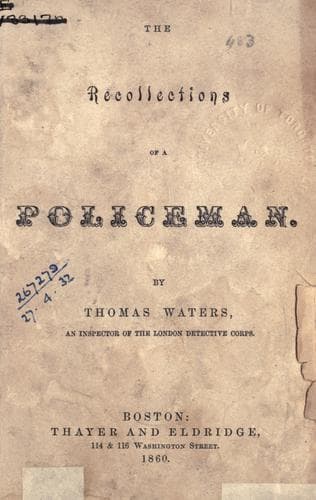
Detective and mystery stories, English; Police -- Fiction; Short stories
Let me first speak of witnesses and their testimony. It is sometimes
supposed that the desire to be veracious is the only quality essential
to form a trustworthy witness--and an essential quality it is beyond all
doubt--but it is possessed by many who are nevertheless very unsafe
guides to truth. In the first place, this general desire for truth in a
mind not carefully regulated, is apt to give way, oftentimes
unconsciously, to impressions which overpower habitual veracity. It may
be laid down as a general rule that witnesses are partisans, and that,
often without knowing it, their evidence takes a color from the feeling
of partisanship, which gives it all the injurious effects of willful
falsehood--nay, it is frequently more pernicious. The witness who
knowingly perverts the truth, often betrays his mendicity by his voice,
his countenance, or his choice of words; while the unconscious perverter
gives his testimony with all the force of sincerity. Let the witness who
intends to give evidence worthy of confidence, be on his guard against
the temptations to become a partisan. Witnesses ought to avoid
consorting together on the eve of a trial; still more, discussing the
matters in dispute, and comparing their intended statements. Musicians
have observed that if two instruments, not in exact accordance, are
played together, they have a tendency to run into harmony. Witnesses are
precisely such instruments, and act on each other in like manner.
So much with regard to the moral tone of the witness; but the
difficulties which I have pointed out may be surmounted, and yet leave
his evidence a very distorted narrative of the real facts. Consideration
must be given to the intellectual requirements of a witness. It was the
just remark of Dr. Johnson that complaints of the memory were often
very unjust toward that faculty which was reproached with not retaining
what had never been confided to its care. The defect is not a failure of
memory, but a lack of observation; the ideas have not run out of the
mind--they never went into it.
This is a deficiency, which cannot be dealt with in any special relation
to the subject in hand; it can only be corrected by cultivating a
general habit of observation, which, considering that the dearest
interests of others may be imperiled by errors arising out of the
neglect to observe accurately, must be looked upon in the light of a
duty.
A still greater defect is the absence of the power of distinguishing
fact and inference. Nothing but a long experience in Courts of Justice,
can give a notion of the extent to which testimony is adulterated by
this defect. It is often exemplified in the depositions of witnesses, or
rather in the comparison between the depositions which, as your readers
know, are taken in writing before the committing magistrate, and the
evidence given on the trial.
Public-domain text, read in full here on John Shaqi.
Reviews
Reviews
No reviews yet
Be the first to share your thoughts on this work.
Elsewhere in the archive
Join the Discussion
Join the discussion
Sign in to leave a comment or review.
Sign InorCreate an account