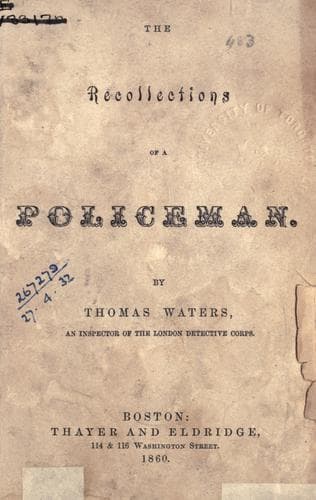
Detective and mystery stories, English; Police -- Fiction; Short stories
Circumstances on which the witness had been silent when examined before
the magistrate shortly after the event, make their appearance in his
evidence on the day of trial; so that his memory purports to augment
inaccuracy in proportion to their time which has elapsed since the
transaction of which he speaks!
I have observed this effect produced in a marvelous degree in cases of
new trial, which in civil suits are often awarded, and which frequently
take place years after the event to which they relate. The comparison of
the evidence of the same witness as it stands upon the short-hand
writer's notes of the two trials, would lead an unpracticed reader to
the conclusion that nothing but perjury could account for the
diversities; and this impression would be confirmed, if he should find,
as in all probability he would, that the points on which the latter
memory was better supplied than the earlier, were just those on which
the greatest doubt had prevailed on the former occasion, and which were
made in favor of the party on whose side the witness had been called.
But the critic would be mistaken. The witness was not dishonest, but had
failed to keep watch over the operations of his own mind. He had perhaps
often adverted to the subject, and often discoursed upon it, until at
length he confounded the facts which had occurred, with the inference
which he had drawn from such facts, in establishment of the existence of
others, which had in reality no place except in his own cogitation, but
which after a time took rank in his memory with its original
impressions.
The best safeguard a witness could employ to preserve the unalloyed
memory of transactions, is to commit his narrative to writing, as soon
after the event as he shall have learned that his evidence respecting
them is likely to be required; and yet I can hardly recommend such a
course, because so little is the world, and even that portion of the
world which passes its life in Courts of Justice, acquainted with what
may be called the Philosophy of Evidence, that a conscientious endeavor
of this kind to preserve his testimony in its purity, might draw upon
him the imputation of having fabricated his narrative; and this is the
more probable, because false witnesses have not unfrequently taken
similar means for abiding by their fictions.
It is worthy of note how much these disturbing causes, both moral and
intellectual, fasten upon these portions of evidence which are most
liable to distortion. Words, as contra-distinguished from facts,
exemplify the truth of this position. Every witness ought to feel great
distrust of himself in giving evidence of a conversation. Language, if
it runs to any length, is very liable to be misunderstood, at least in
passages.
Public-domain text, read in full here on John Shaqi.
Reviews
Reviews
No reviews yet
Be the first to share your thoughts on this work.
Elsewhere in the archive
Join the Discussion
Join the discussion
Sign in to leave a comment or review.
Sign InorCreate an account