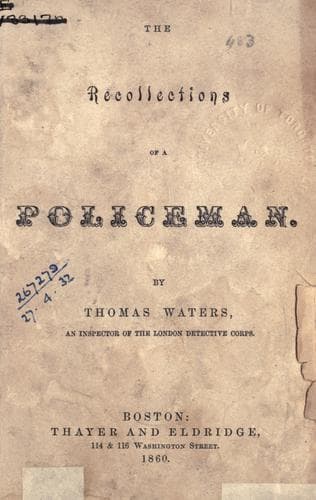
Detective and mystery stories, English; Police -- Fiction; Short stories
judicature and the Tyburn executive much trouble and expense, by hanging
himself in Bridewell.
The success of Mr. Charles Price has never been surpassed, and even
after the darkest era in the history of Bank forgeries--which dates from
the suspension of cash payments, in February, 1797, and which will be
treated of in the succeeding chapter--"Old Patch" was still remembered
as the Cæsar of Forgers.
CHAPTER II.
In the history of crime, as in all other histories, there is one great
epoch by which minor dates are arranged and defined. In a list of
remarkable events, one remarkable event more remarkable than the last,
is the standard around which all smaller circumstances are grouped.
Whatever happens in Mohammedan annals, is set down as having occurred so
many years after the flight of the Prophet; in the records of London
commerce a great fraud or a great failure is mentioned as having come to
light so many months after the flight of Rowland Stephenson. Sporting
men date from remarkable struggles for the Derby prize, and refer to
1840, as "Bloomsbury's year." The highwayman of old dated from Dick
Turpin's last appearance on the fatal stage at Tyburn turnpike. In like
manner, the standard epoch in the annals of Bank-Note Forgery, is the
year 1797, when (on the 25th of February) one-pound notes were put into
circulation instead of golden guineas; or, to use the City idiom, 'cash
payments were suspended.'
At that time the Bank-of-England note was no better in appearance--had
not improved as a work of art--since the days of Vaughan, Mathison, and
Old Patch; it was just as easily imitated, and the chances of the
successful circulation of counterfeits were increased a thousand-fold.
Up to 1793 no notes had been issued even for sums so small as five
pounds. Consequently all the Bank paper then in use, passed through the
hands and under the eyes of the affluent and educated, who could more
readily distinguish the false from the true. Hence, during the fourteen
years which preceded the non-golden and small-note era, there were only
three capital convictions for the crime. When, however, the
Bank-of-England notes became "common and popular," a prodigious
quantity--to complete the quotation--was also made "base," and many
persons were hanged for concocting them.
Public-domain text, read in full here on John Shaqi.
Reviews
Reviews
No reviews yet
Be the first to share your thoughts on this work.
Elsewhere in the archive
Join the Discussion
Join the discussion
Sign in to leave a comment or review.
Sign InorCreate an account