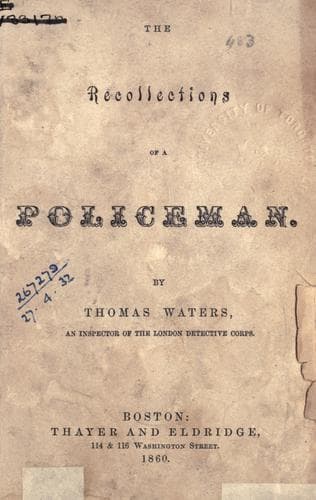
Detective and mystery stories, English; Police -- Fiction; Short stories
To a vast number of the humbler orders, Bank Notes were a rarity and a
"sight." Many had never seen such a thing before they were called upon
to take one or two-pound notes in exchange for small merchandise, or
their own labor. How were they to judge? How were they to tell a good
from a spurious note?--especially when it happened that the officers of
the Bank themselves, were occasionally mistaken, so complete and perfect
were the imitations then afloat. There cannot be much doubt that where
one graphic rascal was found out, ten escaped. They snapped their
fingers at the executioner, and went on enjoying their beef-steaks and
porter--their winter treats to the play--their summer excursions to the
suburban tea-gardens--their fashionable lounges at Tunbridge Wells,
Bath, Margate, and Ramsgate--doing business with wonderful unconcern,
and "face" all along their journeys. These usually expensive, but to
them profitable enjoyments, were continually coming to light at the
trials of the lesser rogues who undertook the issue department; for,
from the ease with which close imitation was effected, the manufacture
was more readily completed than the uttering. The fraternity and
sisterhood of utterers played many parts, and were banded in strict
compact with the forgers. Some were turned loose into fairs and
markets, in all sorts of appropriate disguises. Farmers, who could
hardly distinguish a field of standing wheat from a field of
barley--butchers, who never wielded more deadly weapons than two-prong
forks--country boys, with cockney accents, bought gingerbread, and
treated their so-called sweethearts with ribbons and muslins, all by the
interchange of false "flimseys." The better-mannered disguised
themselves as ladies and gentlemen, paid their losings at cards or
hazard, or their tavern bills, their milliners, and coachmakers, in
motley money, composed of part real and part base bank paper. Some went
about in the cloak of the Samaritan, and generously subscribed to
charities wherever they saw a chance of changing a bad "five" for three
or four good "ones." Ladies of sweet disposition went about doing good
among the poor--personally inquired into distress, relieved it by
sending out a daughter or a son to a neighboring shop for change, and
left five shillings for present necessities, walking off with fifteen.
So openly--in spite of the gallows--was forgery carried on, that whoever
chose to turn utterer found no difficulty in getting a stock-in-trade to
commence with. Indeed, in the days of highwaymen, no traveling-gentleman's
pocket or valise was considered properly furnished without a few forged
notes wherewith to satisfy the demands of the members of the "High
Toby." This offence against the laws of the road, however, soon became
too common, and wayfarers who were stopped and rifled, had to pledge
their sacred words of honor that their notes were the genuine promises
of Abraham Newland, and that their watches were not of the factory of
Mr.
Public-domain text, read in full here on John Shaqi.
Reviews
Reviews
No reviews yet
Be the first to share your thoughts on this work.
Elsewhere in the archive
Join the Discussion
Join the discussion
Sign in to leave a comment or review.
Sign InorCreate an account