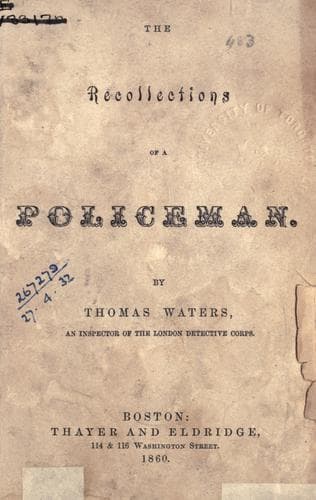
Detective and mystery stories, English; Police -- Fiction; Short stories
Mr. Wallace was soon taught that seven thousand pounds per annum is,
after all, but a poor pittance for the Registrar of a simple bishopric,
when calculated by the ecclesiastical rule of three; for the registry of
Cathedral number two, produces to its fortunate patentees twenty
thousand per annum; about ten thousand a year for the Registrar who does
nothing, and the like amount for his Deputy who helps him.
The portentous personage to whom Mr. Wallace was accredited, received
him in state in the small office surrounded by a Surrogate (apparently
retained on purpose to cross-examine Mr. Wallace) and the clerks. Mr.
Wallace mentioned that he believed the Archbishop had written to the
Deputy-Registrar to afford him every facility in consulting the
documents under his charge. The Deputy Registrar owned that the
Archbishop had done so, but declared that the Archbishop had no
jurisdiction whatever over him; and, claiming as he did, complete
immunity from, and irresponsibility to, all human control, he begged to
say that his Grace the Archbishop, in presuming to write to the
high-authorities of that unimpeachable Registry on such a subject, had
taken a very great liberty. Mr. William Wallace inquired if that was to
be the answer he was expected to convey to the Archbishop? bowed, and
was about to retire, when the awful Deputy recalled him. What did he
want to search for? Mr. Wallace repeated that his object was wholly
literary and archæological. The chief clerk who here came in as a
reinforcement, was so good as to intimate that he "didn't believe a word
of it." Whereupon a strong opinion was added that Mr. Wallace wanted
surreptitiously to obtain pedigrees, and to consult wills. A powerful
battery of cross-questionings was then opened by the heavier
authorities, aided by a few shots from the light-bob, or skirmishing
party--the clerk. But had Mr. William Wallace been his great ancestor,
he could not have held his position against such odds more firmly. At
length the preliminaries of a treaty were proposed by the enemy, the
terms of which were that Mr. Wallace should be allowed to consult any
records dated before the year one thousand four hundred! This was
demured to as utterly useless. Negotiations were then resumed, and the
authorities liberally threw in another century, out of the fullness of a
respect for the Archbishop, which they had refrained from condescending
to express;--Mr. Wallace might consult documents up to the year fifteen
hundred.
With this munificent concession, Mr. Wallace was obliged to be
satisfied, and proceeded to venture on another stipulation:--
The researches which he had proposed to himself at this Cathedral number
two, were elaborate and complicated; they would require such facilities
as had been asked on his behalf by the Archbishop. Could he have access
to the documents themselves?
Public-domain text, read in full here on John Shaqi.
Reviews
Reviews
No reviews yet
Be the first to share your thoughts on this work.
Elsewhere in the archive
Join the Discussion
Join the discussion
Sign in to leave a comment or review.
Sign InorCreate an account