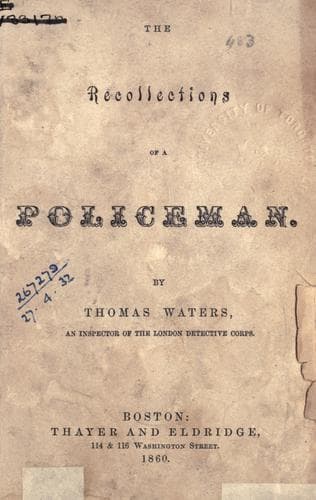
Detective and mystery stories, English; Police -- Fiction; Short stories
The effect which this simple request produced in the office, was
prodigious! A small schoolboy who should, at dinner, ask for a piece of
the master's apple-pie; or a drummer on parade, who should solicit from
his captain a loan of five shillings, could not produce a more sublime
degree of astonishment, than that which glared through the smoke from
the faces of the deputy-registrar, the surrogate, the chief clerk, and
all the junior clerks, then and there assembled. The effect produced
amounted to temporary petrefaction; the principals neither spoke nor
moved; the subordinates left off writing and poking the fire. So
superlative was the audacity of the request, that it paralyzed the
pendulum of that small, rusty, dusty, smoky old ecclesiastical clock,
and stopped the works!
Refusal in words was not vouchsafed to Mr. William Wallace; neither did
he need that condescension. The silent but expressive pantomine was
enough. As the Eastern culprit receives his doom by the speechless
gesture of the judge's hand across his own neck; so Mr. William Wallace
fully understood that, access to the record depositories of the province
appertaining to Cathedral number two, was nearly equivalent to getting
into a freemason's lodge after it has been "tiled," or to obtaining
admission to St. Paul's cathedral without two-pence.
He therefore waved as perfectly impossible that item of the treaty. For
the public, however, the evidence of that gentleman is hardly necessary
to bring them acquainted with the manner in which the trust imposed on
the Registrar and his Deputy is performed; for while the Deputy
Registrar and Mr. William Wallace are settling their differences over
the next clause of their treaty, we shall dip into the reports of the
Ecclesiastical Commission issued in 1832, to show what the state of
things was at that time; and to any one who can prove that those
venerable documents have been by any means rescued from decay since that
year, the public will doubtless be much obliged. At page one hundred and
seventy of the report, Mr. Edward Protheroe, M.P., states, on oath, that
in the instance of every Court he had visited the records suffered more
or less from damp and the accumulation of dust and dirt. Then, speaking
of the Registry of this same Cathedral number two, he declares its
documents to have been in a scandalous state. "I found them," he
continues, "perfectly to accord with the description I had received from
various literary and antiquarian characters who had occasion to make
searches in the office; and I beg leave to remark that the place must
have been always totally inadequate as a place of deposit for the
records, both as to space and security." Some of the writings he found
in two small cells, "in a state of the most disgraceful filth;" others
in "two apertures in the thick walls, scarcely to be called windows; and
the only accommodation for these records are loose wooden shelves, upon
Public-domain text, read in full here on John Shaqi.
Reviews
Reviews
No reviews yet
Be the first to share your thoughts on this work.
Elsewhere in the archive
Join the Discussion
Join the discussion
Sign in to leave a comment or review.
Sign InorCreate an account