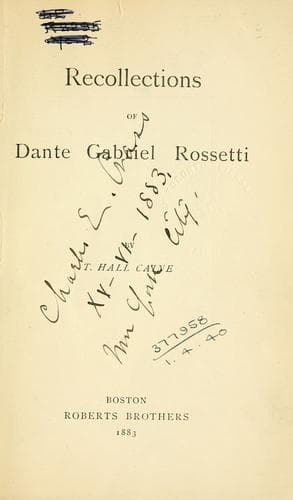
Recollections of Dante Gabriel RossettiCaine, Hall, Sir
Philosophy
Recollections of Dante Gabriel Rossetti
Caine, Hall, Sir
Rossetti, Dante Gabriel, 1828-1882
It was very natural that Coleridge should prove to be one of the first
subjects discussed by Rossetti, who admired him greatly, and when it
transpired that Coleridge was, perhaps, my own chief idol, and that
whilst even yet a child I had perused and reperused not only his poetry
but even his mystical philosophy (impalpable or obscure even to his
maturer and more enlightened, if no more zealous, admirers), the
disposition to write upon him became great upon both sides. “You can
never say too much about Coleridge for me,” Rossetti would write, “for
I worship him on the right side of idolatry, and I perceive you know
him well.” Upon this one of my first remarks was that there was much in
Coleridge’s higher descriptive verse equivalent to the landscape art
of Turner. The critical parallel Rossetti warmly approved of, adding,
however, that Coleridge, at his best as a pictorial artist, was a
spiritualised Turner. He instanced his,
We listened and looked sideways up,
The moving moon went up the sky
And no where did abide,
Softly she was going up,
And a star or two beside--
The charmed water burnt alway
A still and awful red.
I remarked that Shelley possessed the same power of impregnating
landscape with spiritual feeling, and this Rossetti readily allowed;
but when I proceeded to say that Wordsworth sometimes, though rarely,
displayed a power akin to it, I found him less warmly responsive. “I
grudge Wordsworth every vote he gets,” {*} Rossetti frequently said to
me, both in writing, and afterwards in conversation. “The three
greatest English imaginations,” he would sometimes add, “are Shakspeare,
Coleridge, and Shelley.” I have heard him give a fourth name, Blake.
* There is a story frequently told of how, seeing two camels
walking together in the Zoological Gardens, keeping step in
a shambling way, and conversing with one another, Rossetti
exclaimed: “There’s Wordsworth and Ruskin virtuously taking
a walk!”
He thought Wordsworth was too much the High Priest of Nature to be
her lover: too much concerned to transfigure into poetry his
pantheo-Christian philosophy regarding Nature, to drop to his knees in
simple love of her to thank God that she was beautiful. It was hard to
side with Rossetti in his view of Wordsworth, partly because one feared
he did not practise the patience necessary to a full appreciation of
that poet, and was consequently apt to judge of him by fugitive lines
read at random. In the connection in question, I instanced the lines
(much admired by Coleridge) beginning
Suck, little babe, O suck again!
It cools my blood, it cools my brain,
and ending--
The breeze I see is in the tree,
It comes to cool my babe and me.
Public-domain text, read in full here on John Shaqi.
Reviews
Reviews
No reviews yet
Be the first to share your thoughts on this work.
Elsewhere in the archive
Join the Discussion
Join the discussion
Sign in to leave a comment or review.
Sign InorCreate an account