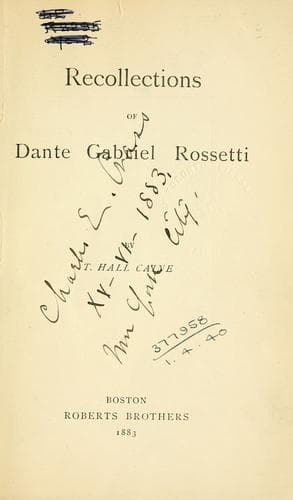
Recollections of Dante Gabriel RossettiCaine, Hall, Sir
Philosophy
Recollections of Dante Gabriel Rossetti
Caine, Hall, Sir
Rossetti, Dante Gabriel, 1828-1882
But Rossetti would not see that this last couplet denoted the point of
artistic vision at which the poet of nature identified himself with her,
in setting aside or superseding all proprieties of mere speech. To him
Wordsworth’s Idealism (which certainly had the German trick of keeping
close to the ground) only meant us to understand that the forsaken
woman through whose mouth the words are spoken (in _The Affliction of
Margaret_ ------ of ------) saw _the breeze shake the tree_ afar off.
And this attitude towards Wordsworth Rossetti maintained down to the
end. I remember that sometime in March of the year in which he died, Mr.
Theodore Watts, who was paying one of his many visits to see him in his
last illness at the sea-side, touched, in conversation, upon the power
of Wordsworth’s style in its higher vein, and instanced a noble passage
in the _Ode to Duty_, which runs:
Stern Lawgiver! yet thou dost wear
The Godhead’s most benignant grace;
Nor know we anything so fair
As is the smile upon thy face;
Flowers laugh before thee on their beds;
And fragrance in thy footing treads;
Thou dost preserve the stars from wrong;
And the most ancient heavens, through Thee, are
fresh and strong.
Mr. Watts spoke with enthusiasm of the strength and simplicity, the
sonorousness and stately march of these lines; and numbered them, I
think, among the noblest verses yet written, for every highest quality
of style.
But Rossetti was unyielding, and though he admitted the beauty of the
passage, and was ungrudging in his tribute to another passage which I
had instanced--
O joy that in our embers--
he would not allow that Wordsworth ever possessed a grasp of the
great style, or that (despite the Ode on Immortality and the sonnet on
_Toussaint L’Ouverture_, which he placed at the head of the poet’s work)
vital lyric impulse was ever fully developed in his muse. He said:
As to Wordsworth, no one regards the great Ode with more
special and unique homage than I do, as a thing absolutely
alone of its kind among all greatest things. I cannot say
that anything else of his with which I have ever been
familiar (and I suffer from long disuse of all familiarity
with him) seems at all on a level with this.
Public-domain text, read in full here on John Shaqi.
Reviews
Reviews
No reviews yet
Be the first to share your thoughts on this work.
Elsewhere in the archive
Join the Discussion
Join the discussion
Sign in to leave a comment or review.
Sign InorCreate an account