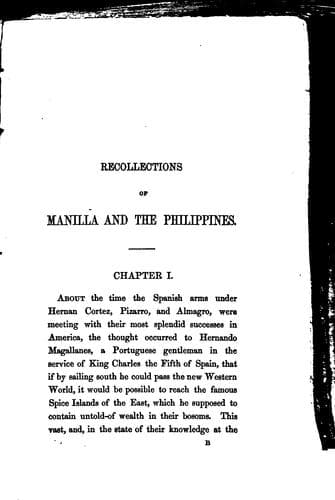
Recollections of Manilla and the Philippines: During 1848, 1849 and 1850 — John Shaqi
Recollections of Manilla and the Philippines: During 1848, 1849 and 1850MacMicking, Robert
History
Recollections of Manilla and the Philippines: During 1848, 1849 and 1850
MacMicking, Robert
Manila (Philippines); Philippines
These gobernadorcillos, or little governors, possess considerable
authority over the natives, for, besides having the chief municipal
authority in their own districts, they are allowed to decide judicially
in civil cases, when the amount in dispute does not exceed the
value of forty-four dollars, or about ten pounds sterling, and in
criminal cases undertake the prosecution, collecting the evidence
and ascertaining the charges against any delinquent within their
district, all of which is remitted by them to the provincial-governor
and judge for his decision. Their election takes place annually,
on the commencement of the new year, all over the country, and their
power is exactly defined in a printed commission which they all hold
from the Governor of the Philippines.
The half-breeds, or people of mixed Chinese and Indian blood, known by
the name of Sangleys, are usually permitted, in districts where their
number is considerable, to elect a Major from among their own class,
whose power over them is exactly similar to that of the captain of
the village where they reside over the aboriginal Indians: they do
not interfere with each other, and are quite independent of any one
save the alcalde of the province. When there are two gobernadorcillos
in the same village, they each look after their own class, whether
Mestizos or natives.
In addition to these local officials there is another curious body of
men, called _Cabezas de barangay_; each of whom has under his charge
about fifty families, whose tribute to government he has to collect,
and for the amount of which he is held accountable.
The persons who fill this office are usually resident in the immediate
neighbourhood or in the same street with those from whom they have to
collect the tribute, and have some slight authority over those who pay
it to them, such as deciding petty quarrels and disputes among them,
&c. The institution of this body is uncertain, and is said to have
been originated by the aboriginal Indians themselves, and to have
been found in full operation at the time of the earliest Spanish
intercourse with them. The probability is, however, that at that
period it was of a military nature, and their duties then were more
to officer the armies of the native kings than for any of the uses
it has been subsequently wisely put to by the white man. The office
is hereditary in their families; but in the event of the person who
exercises it changing his residence, or from other causes becoming
unfit to discharge its duties, a successor is elected in his place.
Public-domain text, read in full here on John Shaqi.
Reviews
Reviews
No reviews yet
Be the first to share your thoughts on this work.
Join the Discussion
Join the discussion
Sign in to leave a comment or review.
Sign InorCreate an account