Recollections of Manilla and the Philippines: During 1848, 1849 and 1850MacMicking, Robert
History
Recollections of Manilla and the Philippines: During 1848, 1849 and 1850
MacMicking, Robert
Manila (Philippines); Philippines
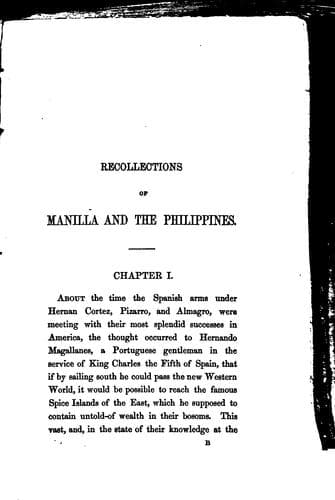
About the time the Spanish arms under Hernan Cortez, Pizarro, and
Almagro, were meeting with their most splendid successes in America,
the thought occurred to Hernando Magallanes, a Portuguese gentleman
in the service of King Charles the Fifth of Spain, that if by sailing
south he could pass the new Western World, it would be possible to
reach the famous Spice Islands of the East, which he supposed to
contain untold-of wealth in their bosoms. This vast, and, in the
state of their knowledge at the time, apparently hardy and even rash
idea, met with approval by the King, who honoured Magallanes with
the distinguished military order of Santiago, and appointed him to
the command of a squadron which he immediately set about fitting out
to accomplish the project, with the view of conquering and annexing
these islands to his crown.
At length, when all the preparations were completed, on the 10th of
August, 1519, six ships, no one of which exceeded 130 tons, and some
of them being less than half that size, sailed from the port of San
Lucan de Barrameda on this bold and perilous enterprise.
In the prosecution of their voyage, many obstacles were encountered;
but everything disappeared before the ardour of their chief,
who, discovering, passed through the Straits of Magellan, which
alone immortalize his name, and spreading his sails to the gale,
stood boldly with his squadron, now reduced to three crazy vessels,
into the unknown and vast ocean which lay open before him, with all
the hardihood characteristic of his time, traversing in its utmost
breadth the Pacific, without, however, chancing to meet with any of
the numerous islands now scattered throughout its extent. At last,
the Mariana or Ladrone Islands were descried on the 16th of August,
1521, and a few days afterwards a cape on the east coast of Mindanao
was seen.
Coasting along the shores of Caraga, the ships anchored off Limasna,
where Magallanes was well received by the natives of the place;
from thence steering towards Cebu, he managed to establish a good
understanding with the country people, although upwards of two
thousand of them had assembled, armed with spears and javelins,
to oppose his landing.
Having constructed a house at this place, in order that mass might
be decently said, he landed to hear it, accompanied by his crews.
The royal family of Cebu, curious to observe the manners of their
strange visitors, attended its celebration, and, as the story
goes, were so much edified by the sight, that they were baptized
Christians, and an oath of allegiance and vassalage to the King of
Spain administered to them; and their example being followed to a
great extent by the nobles and people of Cebu, the Christian forms
of faith and the symbolic cross were planted by the Spaniards in the
country of the antipodes.
Some time afterwards, Magallanes met the end which best becomes a
brave and good soldier, by dying in the battle-field in the cause of
his new friends and allies.
Public-domain text, read in full here on John Shaqi.
Reviews
Reviews
No reviews yet
Be the first to share your thoughts on this work.
Join the Discussion
Join the discussion
Sign in to leave a comment or review.
Sign InorCreate an account