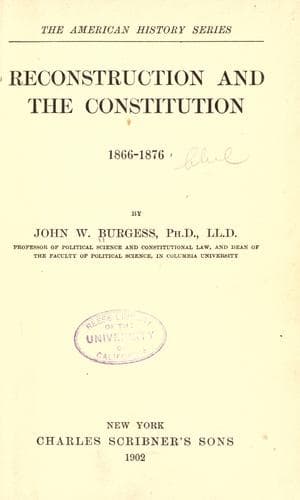
Reconstruction and the Constitution, 1866-1876Burgess, John William
History
Reconstruction and the Constitution, 1866-1876
Burgess, John William
Reconstruction (U.S. history, 1865-1877); United States -- Politics and government -- 1865-1877
These officers betook themselves at once, with the forces attached to
their several commands, to their respective stations, and assumed the
government of their respective districts by martial law. No opposition
whatever was made to any of them by the populations thus made subject
to their despotic rule.
[Sidenote: The President's instructions to the generals in
interpretation of the Reconstruction Acts.]
Very soon, however, the generals found great difficulty in interpreting
the Reconstruction Acts, especially in respect to the oath required for
enfranchisement, both as to the persons who might take it and as to its
consequences, and in respect to the powers of the boards appointed to
superintend the elections. They applied to the President for
information upon these points. The President submitted their
application to his Attorney-General and to his Cabinet, and with the
full concurrence of all the members thereof, except only Mr. Stanton,
issued through the Adjutant-General's office in the War Department, on
the 20th of June, the following instructions:
First: That the oath prescribed in the second Act defined all the
qualifications required for suffrage, and that any person who could
take that oath should have his name entered on the list of voters; that
the boards of registration provided in that Act could not require any
other, or any additional, oath from the person applying for
registration, nor "administer an oath to any other person touching the
qualification of the applicant or {137} the falsity of the oath taken
by him," but that the person taking the oath must be registered as a
voter, and if it could be afterward proved that he had sworn falsely,
he could be punished for perjury.
Second: That an unnaturalized alien could not take the oath, but a
naturalized alien could, and that no other proof of naturalization
could be required of him.
Third: That "actual participation in rebellion or the actual commission
of a felony" did not amount to disfranchisement, but there must be a
law made by competent authority declaring disfranchisement, or a
judicial sentence inflicting it, and that no law of the United States
had declared the penalty of disfranchisement for participating in
rebellion alone.
Fourth: That a person who had engaged in rebellion, but had not
theretofore held an office under a "State" or the United States, or not
been a member of a "State" legislature or of Congress, and not taken,
as such, an oath to support the Constitution of the United States, was
not disfranchised or disqualified from voting.
Fifth: That persons who were militia officers in any "State" prior to
the rebellion were not disfranchised by participating in the rebellion.
Public-domain text, read in full here on John Shaqi.
Reviews
Reviews
No reviews yet
Be the first to share your thoughts on this work.
Elsewhere in the archive
Join the Discussion
Join the discussion
Sign in to leave a comment or review.
Sign InorCreate an account