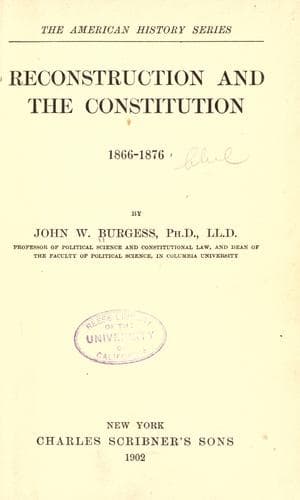
Reconstruction and the Constitution, 1866-1876Burgess, John William
History
Reconstruction and the Constitution, 1866-1876
Burgess, John William
Reconstruction (U.S. history, 1865-1877); United States -- Politics and government -- 1865-1877
Sixth: That "an act to fix upon the person the offence of engaging in
rebellion under this law must be an overt and voluntary act, done with
the intent of aiding or furthering the common unlawful purpose," and
that "a person forced into the rebel service by conscription or under a
paramount authority which he could not safely disobey, and who would
not have entered such service if left to the free exercise of his own
will," was not disfranchised or disqualified from voting.
And lastly: That disloyal sentiments, opinions or sympathies, or
anything said or written which fell short {138} of an incitement to
others to engage in rebellion, did not disfranchise or disqualify from
voting.
Some other instructions were given which were concurred in by the
entire Cabinet, Mr. Stanton included, but the recital of them is not
essential to this narrative. It must be added, however, that the
President's view of the relation of the military commanders to the
"State" governments created under his direction and with his aid was
one which gave these governments a more independent and permanent
character than the language of the Reconstruction Acts seemed to
warrant.
[Sidenote: The Congressional interpretation of the Reconstruction
Acts.]
When, then, the instructions of June 20th to the generals became known,
another bill was introduced into Congress and passed which put the
Congressional interpretation upon the Reconstruction Acts.
It declared that the true intent and meaning of these Acts was that the
civil governments then existing in the "rebel States" of Virginia,
North Carolina, etc., were not legal "State governments," and that, if
thereafter they should be allowed to continue to exist at all, they
must be subject in all respects to the will of the military commanders
of the respective districts, and to the paramount authority of
Congress; and it provided that the generals in command of the
respective districts might suspend or remove any person from any office
under these illegal and pretended governments, and detail or appoint
some other person to discharge the duties and exercise the powers said
to pertain to such office. The acts of the district commanders in
regard to these things were made subject to the disapproval of the
General of the army, but not to that of the President, and stood until
so disapproved. The same powers in regard to these matters were vested,
by this bill, in the General of the army as in the district commanders,
{139} but were not accorded by it to the President; and it was made the
duty of the General of the army and the district commanders to remove
from such pretended offices "all persons who were disloyal to the
United States, or who used their official influence in any manner to
hinder, delay, prevent, or obstruct the due and proper administration
of the Reconstruction Acts."
Public-domain text, read in full here on John Shaqi.
Reviews
Reviews
No reviews yet
Be the first to share your thoughts on this work.
Elsewhere in the archive
Join the Discussion
Join the discussion
Sign in to leave a comment or review.
Sign InorCreate an account