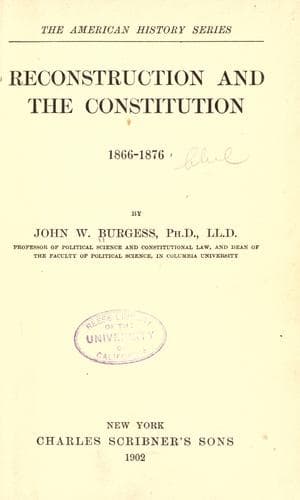
Reconstruction and the Constitution, 1866-1876Burgess, John William
History
Reconstruction and the Constitution, 1866-1876
Burgess, John William
Reconstruction (U.S. history, 1865-1877); United States -- Politics and government -- 1865-1877
Under the delusion that this decision was based entirely upon the
official exemption from jurisdiction of the person sought to be made
defendant, Hon. Charles J. Jenkins, Governor of Georgia, under the
reconstructed constitution of 1865, undertook, as representing the
"State of Georgia," to obtain an injunction against {146} Stanton as
Secretary of War, Grant as General of the army and Pope as commander of
the third military district, restraining them from putting the
Reconstruction Acts of March, 1867, into operation. Mr. Stanbery again
came forward, in the case of the State of Georgia vs. Stanton, with a
most able argument against the jurisdiction of the Court over the
question involved, it being, as he contended, a political question pure
and simple, and the Court again sustained him, deciding that it
possessed no jurisdiction over the subject-matter presented in the bill
for relief.
[Sidenote: The operations of the commanders.]
[Sidenote: The registration.]
The generals now had free hand to go ahead according, pretty much, to
their own discretion. The law gave them, first until September, and
then until October, to complete the registration, and they themselves
appointed and extended the times of registration at will. They
constituted the boards of registry chiefly of army officers, Freedmen's
Bureau officers, discharged Union soldiers, and negroes. Where white
residents could be found who could take the iron-clad oath, the oath
prescribed by Congress July 2d, 1862, they were also used in
constituting these boards. The registration was quite successful in
bringing out most of those qualified to register. The reason for this
was not ready acquiescence on the part of the whites in the
Reconstruction Acts, but it was the calculation that by registering and
not voting on the question of holding a convention, or on the question
of constitutional ratification, one or both of these propositions might
be defeated, since the act of March 23d provided, as we have seen, that
a majority of the registered voters must vote in order to carry them in
the affirmative.
[Sidenote: The numbers registered.]
Public-domain text, read in full here on John Shaqi.
Reviews
Reviews
No reviews yet
Be the first to share your thoughts on this work.
Elsewhere in the archive
Join the Discussion
Join the discussion
Sign in to leave a comment or review.
Sign InorCreate an account