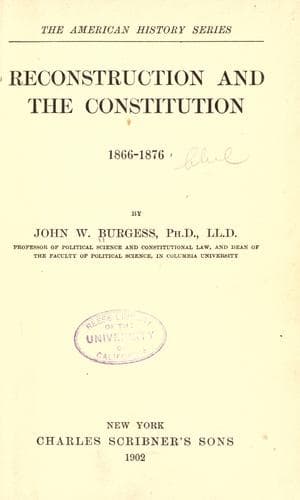
Reconstruction and the Constitution, 1866-1876Burgess, John William
History
Reconstruction and the Constitution, 1866-1876
Burgess, John William
Reconstruction (U.S. history, 1865-1877); United States -- Politics and government -- 1865-1877
In Alabama the registration reached the number of 165,813, of whom
104,518 were negroes or colored. In {147} Arkansas it reached the
number of 66,831, of whom less than half were known to be colored,
although no exact account of the proportion was reported. In Florida it
reached the number of 28,003, of whom 16,089 were colored. In Georgia
it reached the number of 191,501, of whom 95,168 were colored. In
Louisiana it reached the number of 129,654, of whom 84,436 were
colored. In Mississippi it reached the number of 139,690, of whom, it
was well known, a large majority were colored, although no exact
figures giving the proportions were reported. In North Carolina it
reached the number of 179,653, of whom 72,932 were colored. In South
Carolina it reached the number of 127,432, of whom 80,550 were colored.
In Texas it reached the number of 109,130, of whom 49,497 were colored.
In Virginia it reached the number of 225,933, of whom 105,832 were
colored.
[Sidenote: The change in the electorate in the South.]
It will thus be seen that of the ten "States" to be reconstructed five
were to be recreated through an electorate in which the majority would
be negroes and mulattoes, about all of whom had been, three years
before, slaves; while in the other five the majority of the
constructing electorate would be whites by a comparatively small
number. This was a tremendous _bouleversement_ of the political society
of these sections. A large majority of the old leaders were
disfranchised completely and a goodly number of the old Unionists were
deterred by social considerations from taking any part in the work,
while negroes, "poor white trash," "carpet-baggers" and a few
self-denying respectables formed the new electorate for recreating
"State" governments.
There is no doubt that Congress had the constitutional power to do this
thing, on the theory, of course, that these communities were not
"States" of the Union; {148} but it was a reckless thing, and a
monstrous thing. Anybody of common sense and common honesty could, at
the time, have foreseen some of the horrible results which were sure to
follow.
[Sidenote: The elections.]
[Sidenote: Efforts of the commanders to get the vote out.]
Public-domain text, read in full here on John Shaqi.
Reviews
Reviews
No reviews yet
Be the first to share your thoughts on this work.
Elsewhere in the archive
Join the Discussion
Join the discussion
Sign in to leave a comment or review.
Sign InorCreate an account