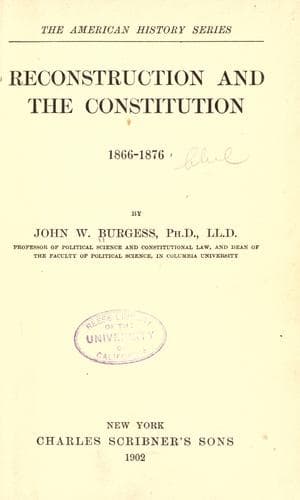
Reconstruction and the Constitution, 1866-1876Burgess, John William
History
Reconstruction and the Constitution, 1866-1876
Burgess, John William
Reconstruction (U.S. history, 1865-1877); United States -- Politics and government -- 1865-1877
law to abolish a co-ordinate department of the Government--in such a
case the President must take the high responsibilities of his office
and save the life of the nation at all hazards. The so-called
Reconstruction Acts, though as plainly unconstitutional as any that can
be imagined, were not believed to be within the class last mentioned.
{160} The people were not wholly disarmed of the power of self-defence.
In all the Northern 'States' they still held in their hands the sacred
right of the ballot, and it was safe to believe that in due time they
would come to the rescue of their own institutions. It gives me
pleasure to add that the appeal to our common constituents was not
taken in vain, and that my confidence in their wisdom and virtue seems
not to have been misplaced." These last words referred undoubtedly to
the recent rejection, by popular vote, in a number of the most
important Northern "States," of proposed amendments to "State"
constitutions conferring suffrage upon negroes.
[Sidenote: The interpretation placed by the Republicans on the
President's Message.]
Most of the Republicans in Congress interpreted this whole paragraph in
the Message as a threat to violate the Reconstruction Acts, although
this was disavowed, rather indistinctly it is true, and to violate also
the Tenure-of-Office Act. It is very difficult to say what the
President was aiming at in giving such a warning to a body already
excited against him to a high degree. It was certainly a _faux pas_ of
the worst kind, to say the least about it.
[Sidenote: The President's special Message concerning the suspension of
Stanton.]
Just nine days later the President sent his special Message to the
Senate in regard to his suspension of Mr. Stanton. The gist of it was
that mutual confidence between himself and Mr. Stanton no longer
existed, and that when he asked Mr. Stanton to resign Mr. Stanton had
declined to do so and had strongly intimated that his reason for
declining was his own lack of confidence in the President's patriotism
and integrity. The President claimed that such an attitude, on the part
of a subordinate toward his superior, was unendurable, was in fact
official misconduct of a grave order, and he also referred to Stanton's
withholding Baird's telegram from {161} him just before the New Orleans
riot. The President furthermore discussed Mr. Stanton's letter in reply
to his order to him suspending him from office and commanding him to
turn over the records and property of the office to General Grant. This
letter contained a declaration by Mr. Stanton denying the right of the
President, under the Constitution and laws, to suspend him from office,
without the advice and consent of the Senate, and without legal cause,
and affirming that he yielded, under protest, to the superior force
wielded by the General of the Army who had been designated to succeed
him.
Public-domain text, read in full here on John Shaqi.
Reconstruction and the Constitution, 1866-1876 — John Shaqi
Reviews
Reviews
No reviews yet
Be the first to share your thoughts on this work.
Elsewhere in the archive
Join the Discussion
Join the discussion
Sign in to leave a comment or review.
Sign InorCreate an account