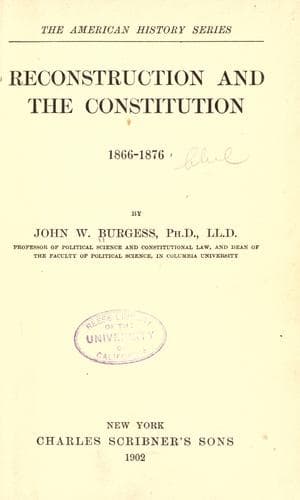
Reconstruction and the Constitution, 1866-1876Burgess, John William
History
Reconstruction and the Constitution, 1866-1876
Burgess, John William
Reconstruction (U.S. history, 1865-1877); United States -- Politics and government -- 1865-1877
This contention of Mr. Stanton that the President could not suspend him
under the Constitution and laws of the United States gave the President
the opportunity of saying that Mr. Stanton must be claiming the
protection of the Tenure-of-Office Act of March 2d, 1867, and of
revealing to the Senate Mr. Stanton's most decided condemnation of that
Act when it was a bill before the President. The President asserted
that Mr. Stanton, as every other member of his Cabinet, advised him
that the bill was unconstitutional, in that it was a dangerous
encroachment upon the President's constitutional prerogatives, and
urged him to veto it. He also said that all the members of his Cabinet
who had been appointed by Mr. Lincoln--and Stanton was one of
these--appeared to be of the opinion that their tenures were not fixed
or affected by the provisions of the bill. The conclusion arrived at by
the President evidently was that the Tenure-of-Office Act did not cover
Mr. Stanton's case, but left it under the law and practice existing
before the passage of that measure, and that if it did cover it, the
Act was unconstitutional, and was so considered by Mr. Stanton himself,
and every other member of the Cabinet.
{162} It is hardly credible that the President intended to recognize
the validity of the Act by sending this Message to the Senate. It is
true that the second section of the Act provided that the President
might suspend an officer during a recess of the Senate, and designate
an _ad interim_ successor, and must, within the first twenty days of
the next meeting of the Senate, report the suspension to the Senate,
and it does appear, from a casual view, that the President was acting
under the authority of this provision, or rather under the duty imposed
by it, in suspending instead of removing Mr. Stanton and in making this
report of Mr. Stanton's suspension to the Senate. But the President
could claim that he was proceeding under his general constitutional
power and duty of suspending from office, as a power included in the
power of removal, and of sending such communications as he saw fit to
Congress or to either House thereof. And the fact that he disputed the
constitutionality of the Act in the Message itself is good internal
evidence that he did not consider that he was in any way acting under
the authority granted to him by it, or in any way estopping himself, so
to speak, from making future declarations against the constitutionality
of the Act, or even from disobeying its requirements.
[Sidenote: The Senate resolution in regard to the suspension of
Stanton.]
Public-domain text, read in full here on John Shaqi.
Reviews
Reviews
No reviews yet
Be the first to share your thoughts on this work.
Elsewhere in the archive
Join the Discussion
Join the discussion
Sign in to leave a comment or review.
Sign InorCreate an account