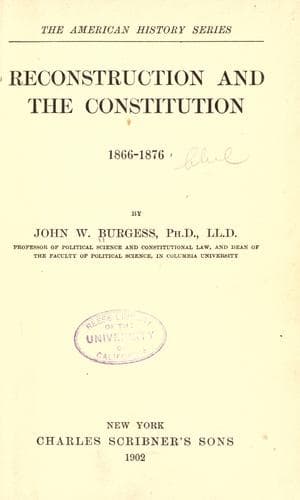
Reconstruction and the Constitution, 1866-1876Burgess, John William
History
Reconstruction and the Constitution, 1866-1876
Burgess, John William
Reconstruction (U.S. history, 1865-1877); United States -- Politics and government -- 1865-1877
The other point is the proposition to found "State" government upon ten
per centum of the population of the "State." Now we know that "State"
government in the federal system of the United States is local
self-government. But local self-government cannot really exist where
the part of the population holding the legal authority does not really
possess the sinews of power; and where the conditions of the society
are democratic, or anything like democratic, one-tenth of the
population cannot really possess the sinews of power. The actual power
to make their government valid, to enable their government to govern
would have to come from the outside. While this may happen under
certain temporary exigencies without destroying local self-government
on the whole, yet it cannot be permitted as a principle upon which to
build a local self-government, a "State" in a federal system.
Provincial governments, Territorial governments may be sustained in
that way, but the distinguishing principle of "State" government
forbids it. It is simply not "State" government when holding in this
way the power to govern, as the principle of its life, no matter what
name we may give it. Upon this point, then, Mr. Lincoln's reasoning was
crude and erroneous, and when applied was destined to result in
mischievous error.
{14} [Sidenote: Reconstruction in Louisiana under Mr. Lincoln's plan.]
[Sidenote: The election of members of Congress.]
As far back as the first week in December of 1862 General Shepley, then
Military Governor of Louisiana, had, by permission from the President,
ordered an election for members of Congress, in the districts over
which his jurisdiction extended. The President had cautioned him
against any choice of Northern men at the point of the bayonet, and had
declared to him that such a procedure would be "disgraceful and
outrageous." The General heeded the warning, and two old citizens of
Louisiana, Messrs. Hahn and Flanders, were chosen, and were admitted by
the House of Representatives to their seats. This happened in February
of 1863, and it was certainly good evidence that the House of
Representatives was, at that moment, resting on the theory of the
perdurance of the "State" of Louisiana throughout the rebellion within
its limits against the United States.
[Sidenote: The New Orleans convention.]
[Sidenote: The election of a governor.]
[Sidenote: The constitutional convention of April, 1864, and the
constitution framed by it and adopted by the voters.]
Public-domain text, read in full here on John Shaqi.
Reviews
Reviews
No reviews yet
Be the first to share your thoughts on this work.
Join the Discussion
Join the discussion
Sign in to leave a comment or review.
Sign InorCreate an account