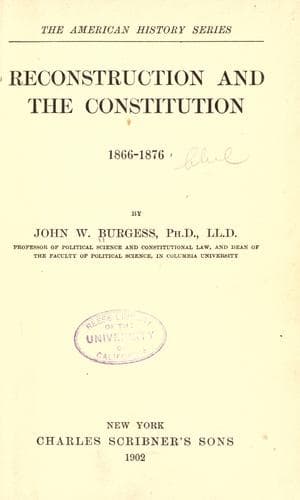
Reconstruction and the Constitution, 1866-1876Burgess, John William
History
Reconstruction and the Constitution, 1866-1876
Burgess, John William
Reconstruction (U.S. history, 1865-1877); United States -- Politics and government -- 1865-1877
There is no question now in any calm and impartial mind that the Senate
acted most inconsiderately, not to say wrongfully, in passing that
resolution. The situation was a perfectly plain one. The President and
Stanton could not work together, since they had lost all confidence in
each other. Common-sense and common decency required in such a case the
retirement of the subordinate. The Senate itself had committed itself
to this view in the discussion and votes upon the Tenure-of-Office
bill, in its original form and in its final form. General Grant, the
man who stood first in the confidence of the whole people, was in
possession of the War Office. He had held it already nearly six months,
and had in that short time improved the administration of it very
greatly. At the end of the six months, at farthest, the President was
held by the law of 1795, a law whose constitutionality {164} he did not
dispute, to make a nomination to the Senate of a permanent incumbent.
The Senate would then be able to prevent the appointment of any person
to the office who did not have the confidence of the Senate and the
country. No possible harm could thus have come to the country from
acquiescing in Stanton's suspension, and it is hard to see that
anything but harm did come to it in not doing so. No perfectly fair and
unprejudiced mind could have failed to see that then; but the radical
Republicans--and most of the Republicans in Congress at that moment
were radical, or at least intensely partisan--were bent upon attacking
and destroying the President in any way they could. They were ready to
lay traps for him, and then to so excite him by encroachments upon the
prerogatives and the dignity of his office as to make him fall into
them. They were determined to sustain Stanton against the President,
the subordinate against his lawful superior, simply because they
despised the President. They claimed that the welfare of the country
demanded it, and most of them probably thought so, but everybody can
see the fallacy of that now, and anybody fit to be a Senator of the
United States ought to have been able to see it then.
[Sidenote: Criticism of General Grant's act.]
Public-domain text, read in full here on John Shaqi.
Reviews
Reviews
No reviews yet
Be the first to share your thoughts on this work.
Elsewhere in the archive
Join the Discussion
Join the discussion
Sign in to leave a comment or review.
Sign InorCreate an account