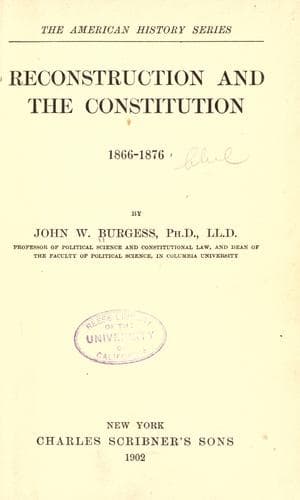
Reconstruction and the Constitution, 1866-1876Burgess, John William
History
Reconstruction and the Constitution, 1866-1876
Burgess, John William
Reconstruction (U.S. history, 1865-1877); United States -- Politics and government -- 1865-1877
It is also a question whether General Grant did not act hastily, and
inconsiderately, not to say wrongfully, in yielding the post without
dispute to Mr. Stanton. The President certainly understood General
Grant to promise him to hold on to the office in case the Senate should
not approve of Stanton's suspension, and thereby compel Stanton to have
recourse to the courts to regain possession, and thus secure a judicial
determination of the constitutionality of the Tenure-of-Office Act, or
to give the office back to the President before the Senate reached its
{165} determination, so that he might have opportunity to put it into
the hands of a man who would be willing to incur this responsibility;
and the President was able to back this understanding by the testimony
of five members of his Cabinet. On the other hand, General Grant was
just as sincere in his view that his remarks to the President on the
subject did not amount to a promise, and if they did, he had fulfilled
it when on the 11th of January, two days before the Senate acted, he
indicated to the President his unwillingness to involve himself in a
lawsuit to test the constitutionality of the Tenure-of-Office Act. It
is true that when he spoke with the President, on the 11th, he did not
offer to resign the office, and that it was understood that he would
see the President again on the subject, and that he did not see the
President, nor attempt to see him, before the Senate acted. But he
explained this apparent failure to keep faith by saying that he was
extremely busy during the two days between the 11th and the 13th, and
that the Senate had acted much more hastily than he expected it would.
There is little doubt that General Grant thought the Senate would
acquiesce in Stanton's suspension, and was taken by surprise when it
did not do so, and that until the action of the Senate on the 13th, he
had never seriously considered that any opportunity or necessity for a
judicial proceeding would arise. When, then, the alternative was
suddenly presented to him of obeying the Tenure-of-Office Act, or
disputing its constitutionality by forcibly holding possession of the
War Office, he decided that it would be wrong for the General of the
army to assume the attitude of defiance to Congress, whatever a
civilian might consider his duty to be. He thought that such an act on
his part would look like a contest between the civil and military
powers of the Government, and he was unwilling to provoke it.
{166} [Sidenote: The President's blunder in his attitude toward Grant.]
Public-domain text, read in full here on John Shaqi.
Reviews
Reviews
No reviews yet
Be the first to share your thoughts on this work.
Elsewhere in the archive
Join the Discussion
Join the discussion
Sign in to leave a comment or review.
Sign InorCreate an account