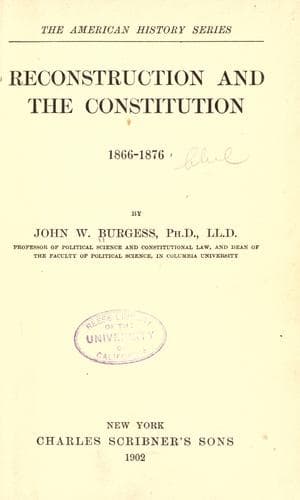
Reconstruction and the Constitution, 1866-1876Burgess, John William
History
Reconstruction and the Constitution, 1866-1876
Burgess, John William
Reconstruction (U.S. history, 1865-1877); United States -- Politics and government -- 1865-1877
General Grant's letter closing the controversy is dated February 11th.
In the interval between his quitting the War Office and this latter
date, the President instructed the General not to obey any orders from
Stanton until he knew they came from the President. This instruction
was given, first, verbally on January 19th. Grant demanded, on January
24th, a written order from the President on the subject, and repeated
this request on the 28th. The President replied on the 29th that
"General Grant is instructed, in writing, not to obey any order from
the War Department, assumed to be issued by the direction of the
President, unless such order is known by the General commanding the
armies of the United States to have been authorized by the Executive."
Grant responded, on January 30th, that he had been informed by the
Secretary of War that he (the Secretary) had not received from the
Executive any order or instructions limiting or impairing his authority
to issue orders to the army as had theretofore been his practice under
the law and the customs of the Department, and that while this
authority to the War Department was not countermanded it would be
satisfactory evidence to him (the General) that any orders issued from
the War Department by the formal direction of the President were
authorized by the Executive. This was coming very nearly up to the
{168} line between obedience and disobedience on the part of the
General of the army toward the constitutional Commander-in-chief of the
army and navy of the United States. The General must have himself felt
that he was on rather shaky ground, for in the closing paragraph of his
letter of February 11th he disclaimed any intention of disobeying "any
legal order of the President distinctly communicated." But this was
still an ambiguous situation. Who was to determine whether an order of
the President to the General was legal or not? If the President, then
there was no need of qualifying the word "order" by the word "legal."
The language used, therefore, indicates that the General considered it
within _his_ power to decide this question. But if the subordinate can
determine upon the legality of the orders of his superior, and disobey
them in case he considers them illegal, then farewell to all discipline
in civil or military service. It is very clear from these expressions
of the General that Stanton's successful insubordination was already
exercising its demoralizing influence, and was confusing the minds of
those high in command in regard to the interpretation of their duties
and responsibilities.
[Sidenote: The unbearable situation in which the President now found
himself.]
Public-domain text, read in full here on John Shaqi.
Reviews
Reviews
No reviews yet
Be the first to share your thoughts on this work.
Elsewhere in the archive
Join the Discussion
Join the discussion
Sign in to leave a comment or review.
Sign InorCreate an account