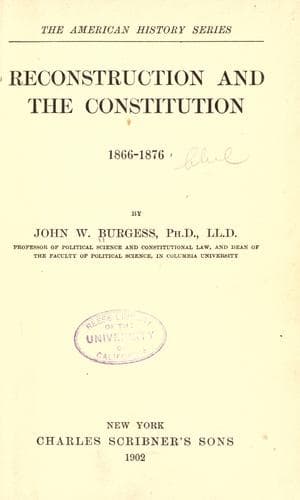
Reconstruction and the Constitution, 1866-1876Burgess, John William
History
Reconstruction and the Constitution, 1866-1876
Burgess, John William
Reconstruction (U.S. history, 1865-1877); United States -- Politics and government -- 1865-1877
The President blundered very seriously when he did not accept the
explanation from General Grant and drop the matter. The General was
friendly in his feelings toward the President, and when Stanton
repossessed himself of the War Office in his cavalier way, without
seeking any understanding with Grant, and sent the General a rude
summons to wait upon him, the General was very naturally and properly
indignant with Stanton. The way was here open for the President to make
a close friend of General Grant, by simply appreciating Grant's point
of view in surrendering the War Office, and saying nothing more about
it. But the President was not a prudent man when crossed in his
purposes. He generally thought that the motives of all men who differed
with him were bad. He showed in this trait his common origin and his
vulgar breeding. He thought that Grant had deceived him and made a
scapegoat of him, and he resolved to have it out with him. He did not
seem to understand at all that in an issue of veracity between General
Grant and himself, the country would believe Grant, no matter who told
the truth, and who the lie. The utter impossibility of coming out
winner in a contest with a national hero, no matter what the merits of
the case might be, does not seem to have occurred to him at all. And so
he plunged into that unfortunate controversy with General Grant in the
public prints, which made Grant his enemy for life, at a time when he
needed most his friendship, and might have had it by the exercise of a
little common prudence.
[Sidenote: The result of the controversy between the President and
General Grant.]
The outcome of this whole course of crimination and recrimination was
that the country came to the belief that the President first tried to
force the responsibility of a violation of the Tenure-of-Office Act
upon the popular General of the army, and then, when the {167} General
foiled him in his purpose, undertook to impugn his honor and his
integrity, and destroy his character before the public. An impartial
study of the facts and the correspondence will not sustain any such
view now, but in the state of feeling then prevailing, no such
impartial study was possible. The President ought to have known this,
and to have controlled his indignation until a more propitious time.
[Sidenote: Grant's disobedience toward the President.]
Public-domain text, read in full here on John Shaqi.
Reviews
Reviews
No reviews yet
Be the first to share your thoughts on this work.
Elsewhere in the archive
Join the Discussion
Join the discussion
Sign in to leave a comment or review.
Sign InorCreate an account