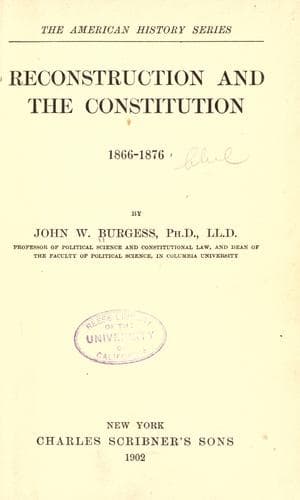
Reconstruction and the Constitution, 1866-1876Burgess, John William
History
Reconstruction and the Constitution, 1866-1876
Burgess, John William
Reconstruction (U.S. history, 1865-1877); United States -- Politics and government -- 1865-1877
Thomas then left the Secretary's room and went into his old room, the
Adjutant-General's room, to have a copy of the order made. He returned
at once with it, and when he handed it to Mr. Stanton, the latter said:
"I do not know whether I will obey your instructions, or whether I will
resist them." General Thomas had certified the correctness of the copy,
and had signed himself Secretary of War _ad interim_. The two then went
into General Schriver's room just across the hallway, and there Stanton
declared outright that Thomas should not issue orders as {170}
Secretary of War, and that if he did he (Stanton) would countermand
them, and he then and there directed General Schriver and General
Townsend, both of whom were present, to disobey any orders coming from
General Thomas as Secretary of War. Mr. Stanton then caused General
Townsend to prepare a written order to Thomas, signed by Mr. Stanton as
Secretary of War, which was as follows: "Sir: I am informed that you
presume to issue orders as Secretary of War _ad interim_. Such conduct
and orders are illegal, and you are hereby commanded to abstain from
issuing any orders other than in your capacity as Adjutant-General of
the army."
[Sidenote: Thomas and the President.]
General Thomas then went over to the White House to see the President
about the matter. He told the President of his conversation with Mr.
Stanton, and repeated to him Stanton's replies verbatim. The President
simply said to him: "Very well; go and take charge of the office and
perform the duties." Thomas did not, however, return to the Secretary's
room in the War Office that day, and did not see Mr. Stanton again on
that day.
[Sidenote: The attitude of the Senate toward the dismissal of Stanton.]
While these things were occurring in the executive offices matters were
seething at the other end of the avenue. The Senate was deliberating,
if we may call such a stormy procedure as took place a deliberation,
upon the President's communication. It very quickly passed the
following resolution: "Whereas, the Senate have received and considered
the communication of the President stating that he had removed Edwin M.
Stanton, Secretary of War, and had designated the Adjutant-General of
the army to act as Secretary of War _ad interim_: Therefore, Resolved
by the Senate of the United States, That under the Constitution and
laws of the United States the President has no power to remove {171}
the Secretary of War and designate any other officer to perform the
duties of that office _ad interim_." A copy of this resolution was sent
to the President, another copy to Mr. Stanton, and another to General
Thomas.
[Sidenote: The movements in the House of Representatives.]
Public-domain text, read in full here on John Shaqi.
Reviews
Reviews
No reviews yet
Be the first to share your thoughts on this work.
Elsewhere in the archive
Join the Discussion
Join the discussion
Sign in to leave a comment or review.
Sign InorCreate an account