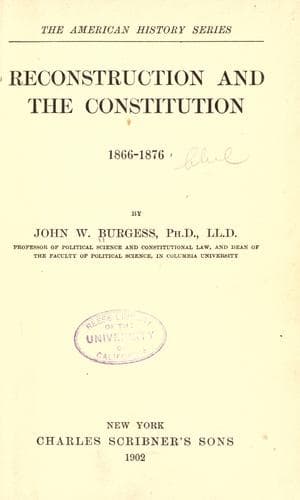
Reconstruction and the Constitution, 1866-1876Burgess, John William
History
Reconstruction and the Constitution, 1866-1876
Burgess, John William
Reconstruction (U.S. history, 1865-1877); United States -- Politics and government -- 1865-1877
The excitement in the other House was still more intense and
irrational. The Senate resolution had hardly passed when the radical
Mr. Covode presented a motion to the effect that "Andrew Johnson,
President of the United States, be impeached of high crimes and
misdemeanors." This resolution was referred to the Committee of the
House on Reconstruction, which was, as we have seen, composed of
members nearly all of whom were radical Republicans.
[Sidenote: The arrest of General Thomas.]
Encouraged and strengthened by these movements in the legislature, and
hearing that Thomas had threatened to force his way into the office,
Mr. Stanton resolved to forestall all possible movements of General
Thomas for gaining possession of the office of Secretary of War. He
procured a warrant of arrest for the General, and on the next morning,
the morning of the 22d, the warrant was served on General Thomas just
after he had risen from his bed, and before he had taken his morning
meal. The officers who arrested him, the Marshal of the District, and
his assistant, and a constable, took the General at once before Judge
Cartter, the Chief Justice of the District of Columbia. On the way from
the General's residence to the court-room, the General asked the
officers to allow him to see the President, and inform the latter of
his arrest. The Marshal went with the General to the White House, and
was present at the interview between the General and the President. It
lasted but a moment. The General told the President that he was under
arrest. The President replied that he was {172} satisfied to have the
case go into the courts, that he wanted it judicially determined. He
then directed the General to go to the Attorney-General, Mr. Stanbery.
The Marshal permitted him to call at Mr. Stanbery's apartment in his
hotel, and inform the Attorney-General of his arrest. He then took him
before Judge Cartter. Nobody was with the General before the Judge,
except the officers who had arrested him. The Judge held him to bail in
the sum of five thousand dollars to appear on the following Wednesday
morning, the 26th. After about an hour friends of the General came in
and signed his bail bond, and the General was released, the Judge
informing him that he was not suspended from any of his official
functions. The General then went back to the White House and informed
the President of his release under bail, and the President again
replied that he wanted the case in the courts.
[Sidenote: Thomas's second attempt to take possession of the War
Office.]
Public-domain text, read in full here on John Shaqi.
Reviews
Reviews
No reviews yet
Be the first to share your thoughts on this work.
Elsewhere in the archive
Join the Discussion
Join the discussion
Sign in to leave a comment or review.
Sign InorCreate an account