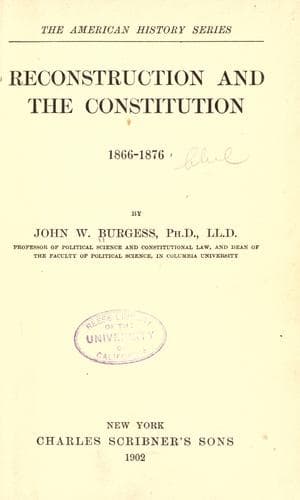
Reconstruction and the Constitution, 1866-1876Burgess, John William
History
Reconstruction and the Constitution, 1866-1876
Burgess, John William
Reconstruction (U.S. history, 1865-1877); United States -- Politics and government -- 1865-1877
An incident occurred at this point in the history of the procedure,
which should be related, although it interrupts somewhat the thread of
the narrative. It was the disappearance of Mr. Black from among the
counsel for the President, and the appearance of Mr. Groesbeck in his
place. It was the gossip among the enemies of the President, and this
gossip was sedulously spread abroad throughout the whole country by
them, that Black on examining the case had become convinced of the
President's guilt and had retired from the case for this reason, and
for the further reason that he had become disgusted with the
President's conduct. It did not become known until later that during
this time Judge Black was counsel for a firm composed of one Patterson
and one Marguiendo, which firm claimed a guano island in the West
Indies, called Alta Vela, and that one of Judge Black's colleagues in
the prosecution of the Patterson-Marguiendo claim, one J. W. Shaffer,
procured a letter of the date of the 9th of March, 1868, that is one
week after the House of Representatives had resolved to impeach the
President, signed by General Benjamin F. Butler and approved by John A.
Logan, J. A. Garfield, W. H. Koontz, J. K. Moorhead, Thaddeus Stevens,
J. G. Blaine and John A. Bingham, some of them the most bitter among
the President's enemies, which contained the statement that these
gentlemen were clearly of the opinion that the citizens of the United
States had the exclusive right to the guano beds of Alta Vela island,
and an expression of their {178} surprise that the President had not
upheld this right by force against the claims of the Dominican
Government to the island, and caused this letter to be placed in the
hands of the President on the 16th day of March, and that on the 17th
or 18th of March Judge Black had an interview with the President and
urged him to send an armed vessel of the United States to Alta Vela to
take possession of the island, and that the President, viewing this
approach to him at this time as an attempt to take advantage of his
situation, refused, and that on the next day, the 19th of March, Judge
Black declined to appear further as the President's counsel in the
impeachment trial.
It must have taken a good deal of self-control on the part of the
President, in possession of all these facts, to keep them quietly to
himself for more than a month from the time of Judge Black's retirement
from his case, while his enemies were pointing the finger of a supposed
triumphant scorn at him as being unworthy to have so honest a man as
Judge Black among his counsel, and then to allow them to be given out
only under provocation from the managers of the impeachment, taunting
him with his treatment of Judge Black, and with Judge Black's
withdrawal from his case.
[Sidenote: The contents of the President's answer.]
Public-domain text, read in full here on John Shaqi.
Reviews
Reviews
No reviews yet
Be the first to share your thoughts on this work.
Elsewhere in the archive
Join the Discussion
Join the discussion
Sign in to leave a comment or review.
Sign InorCreate an account