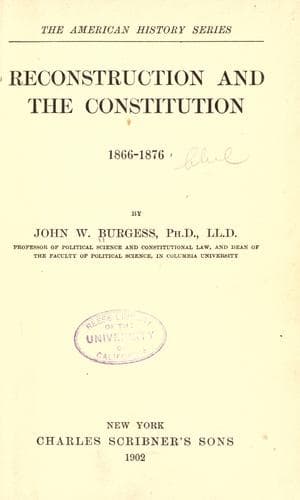
Reconstruction and the Constitution, 1866-1876Burgess, John William
History
Reconstruction and the Constitution, 1866-1876
Burgess, John William
Reconstruction (U.S. history, 1865-1877); United States -- Politics and government -- 1865-1877
But to return to the President's answer to the charges against him.
Disregarding again legal verbiage and order, the President answered
substantially that Stanton's case was not affected by the
Tenure-of-Office Act, and that he held his office, according to the
Constitution and laws of the United States, and the wording of his
commission, at the pleasure of the President; that even if Stanton's
case were covered by the Act, the President was within his right and
was not thereby committing any crime or misdemeanor at all, to so act
as to make up an issue {179} before the Supreme Court of the United
States, whereby the constitutionality of the Act might be tested; that
the authority given to General Thomas to act as Secretary of War _ad
interim_ was not an appointment nor an attempt to make an appointment,
but was only a designation of a person to act temporarily until an
appointment could be made by and with the consent of the Senate, a
thing which the President was empowered to do by the Act of February
13th, 1795, still in force; that he had not entered into any conspiracy
with Thomas or anybody else to force Stanton out of the War Office, or
to seize the property and papers of the United States in the War
Office, that he could not in fact do so, since Stanton was not lawfully
in the War Office, and since the President of the United States was the
ultimate lawful custodian of the property and papers of the United
States in the War Office, but that his communications with Thomas were
orders from the President to a subordinate officer, to whom the
President gave no authority to use force for their execution, and who
did not use any force in his attempts to execute them, the intention of
the President only being, if his authority should be resisted by Mr.
Stanton, to create an issue before the Supreme Court of the United
States, and secure thereby a judicial determination of the rights and
powers of the parties concerned, and not to do anything unlawful; that
he had never undertaken to induce General Emory to take his orders
immediately from himself in violation of the Act of March 2d, 1867,
which provided that all of the military orders and instructions issuing
from the President and the Secretary of War should pass through the
hands of the General of the Army, but that he had only expressed to
General Emory, as he had to Congress, his conviction that the Act was
in violation of the Constitution, which latter {180} conferred upon the
President the Commandership-in-chief of the army and the navy; and
finally, that his speeches were simply the expression of his opinions
as a free citizen of the Republic, which right was guaranteed to him
and to every other citizen by the Constitution of the country, and
could not be made out in any way to have any of the qualities of a
crime or a misdemeanor, and that his declaration that the Thirty-ninth
Congress was a Congress of only a part of the "States" was intended by
Public-domain text, read in full here on John Shaqi.
Reviews
Reviews
No reviews yet
Be the first to share your thoughts on this work.
Elsewhere in the archive
Join the Discussion
Join the discussion
Sign in to leave a comment or review.
Sign InorCreate an account