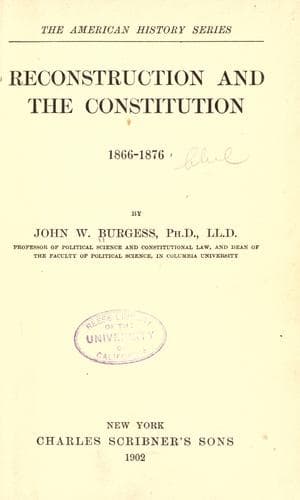
Reconstruction and the Constitution, 1866-1876Burgess, John William
History
Reconstruction and the Constitution, 1866-1876
Burgess, John William
Reconstruction (U.S. history, 1865-1877); United States -- Politics and government -- 1865-1877
The law governing the President's case was perfectly clear to anyone
who could divest himself of political prejudice and of personal
hostility. It was briefly this. By an Act of the First Congress, of the
date of August 7th, 1789, Congress interpreted the Constitution as
giving the President the power to remove any officer of the United
States, except judges of the United States courts, at his discretion,
as an incident of his sole executive responsibility, and in an especial
sense recognized this constitutional power as belonging to the
President in the case of the heads of the governmental departments, the
members of the Cabinet, as they afterwards came to be called, since
these persons stood, and must stand, in a peculiarly confidential
relation to the President, as his official advisers. This
interpretation of the Constitution as to the President's power of
removal and the practice built upon it remained untouched by the
Congress until the 2d of March, 1867, when, as we have seen, Congress
enacted, "that every person holding any civil office to which he has
been appointed by and with the advice and consent of the Senate, and
every person who shall be hereafter appointed to any such office, and
shall become duly qualified to act therein, is and shall be entitled to
hold such office until a successor shall have been in like manner
appointed and duly qualified, except as herein otherwise provided:
Provided, That the Secretaries of State, of the Treasury, of War, of
the Navy, and of the Interior, the Postmaster-General, and the
Attorney-General, shall hold their offices respectively for and during
the term of the President by whom they may have been {185} appointed,
and one month thereafter, subject to removal by and with the advice and
consent of the Senate."
It will be remembered that in the Tenure-of-Office bill as it
originated in the Senate the members of the Cabinet were entirely
excepted from its operation; that the House in passing the bill
included them; that the Senate would not agree to their inclusion; that
the bill was then sent to a conference committee; that this committee
invented the compromise contained in the proviso; that this proviso was
understood to give to each President the power to choose his own
Cabinet officers once during his term, and therefore to remove any
Cabinet officer not originally appointed by him, but holding under a
commission from a former President, and remaining in office only by the
sufferance of the existing President; that this was especially the true
meaning of the proviso in regard to those Cabinet officers then in
office, but who had been appointed and commissioned by Mr. Lincoln
during his first term to hold during the pleasure of the President; and
that it was upon this explanation of the meaning of the proviso that
the Senate voted the resolution of the conference committee.
Public-domain text, read in full here on John Shaqi.
Reviews
Reviews
No reviews yet
Be the first to share your thoughts on this work.
Elsewhere in the archive
Join the Discussion
Join the discussion
Sign in to leave a comment or review.
Sign InorCreate an account