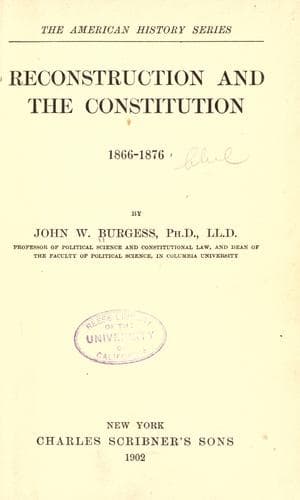
Reconstruction and the Constitution, 1866-1876Burgess, John William
History
Reconstruction and the Constitution, 1866-1876
Burgess, John William
Reconstruction (U.S. history, 1865-1877); United States -- Politics and government -- 1865-1877
Judge Curtis was so influenced by the consideration that to claim such
a power for the President would give him a double veto upon all of the
acts of Congress, a veto when acting as a part of the legislature in
the enactment of law, and then a purely executive veto which could be
overcome only by an adverse judicial decision, that he expressed his
contention on the subject in very {183} cautious language. He declared
that the President claimed no such general power as that, but he said
"when a question arises whether a particular law has cut off a power
confided to him by the people through the Constitution, and he alone
can raise that question, and he alone can cause a judicial decision to
come between the two branches of the Government to say which of them is
right, and after due deliberation, with the advice of those who are his
proper advisers, he settles down firmly upon the opinion that such is
the character of the law, it remains to be decided by you, Senators,
whether there is any violation of his duty when he takes the needful
steps to raise that question and have it peacefully decided."
The great lawyer refused thus to commit himself upon this fundamental
question of constitutional law. And well he might, for to recognize any
such power in the President would be to enable him to rule with such
arbitrariness as to upset the principles and practices of all free
government. The President can constitutionally defend his prerogatives
with the veto power, a power which nothing short of a two-thirds
majority of both Houses of Congress can overcome, and he has no other
power of defence confided to him by the Constitution. He must execute
the laws passed over his veto upon matters which in his opinion touch
his executive prerogatives, just the same as upon all other matters,
and if persons not connected with the administration of the laws do not
call such measures in question before the courts, the remedies provided
by the Constitution for the people of the United States are either the
election of members of Congress who will repeal the enactments, or else
the amendment of the Constitution so as to repeal them. It was,
however, a question whether, in showing the sole purpose of making an
issue before the courts, the {184} President would not clear himself of
any criminal intent. Happily his case did not require this, as was
demonstrated by his counsel and by Senators Trumbull and Fessenden in
their opinions.
[Sidenote: The law in the case.]
Public-domain text, read in full here on John Shaqi.
Reviews
Reviews
No reviews yet
Be the first to share your thoughts on this work.
Elsewhere in the archive
Join the Discussion
Join the discussion
Sign in to leave a comment or review.
Sign InorCreate an account