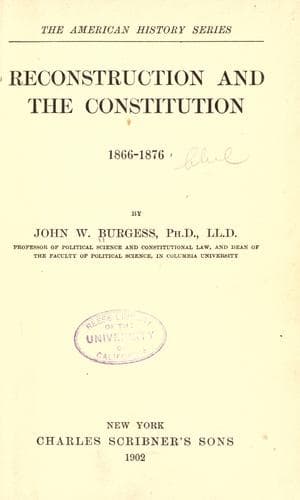
Reconstruction and the Constitution, 1866-1876Burgess, John William
History
Reconstruction and the Constitution, 1866-1876
Burgess, John William
Reconstruction (U.S. history, 1865-1877); United States -- Politics and government -- 1865-1877
It will be seen that neither of these statutes provided for the
temporary filling of vacancies in any of the Departments, except those
of State, the Treasury, and War. In practice, however, the Presidents
have followed the analogies of the law of 1795, when it became
necessary, in their opinion, to make a temporary designation in the
other Departments. On the 22d of September, 1862, President Lincoln
appointed J. B. L. Skinner Postmaster-General _ad interim_. It was Mr.
Lincoln himself {187} who called the attention of Congress to the fact
that he had no literal legal authority for this, and who on January 2d,
1863, asked Congress to extend the Act of May 8th, 1792, so as to cover
the cases of the other Departments, and empower the President to make
_ad interim_ appointments to fill vacancies in these Departments
happening on account of death, sickness, or absence from the seat of
government. Why the President did not ask for the extension of the Act
of February 13th, 1795, which covered all vacancies happening from
whatever cause, instead of the Act of 1792, which covered those only
which might happen from death, sickness, or absence from the seat of
government, we do not know. We only know that in January, 1863, both
the President and Congress were greatly pressed by the exigencies of
the war, and did things generally in haste and without much
consideration. In answer to the President's suggestion, Congress passed
the Act of February 20th, 1863, extending the Act of 1792 so as to
cover all the executive Departments in the cases of vacancy provided
for in that Act, viz., by cause of death, sickness, or absence from the
seat of Government--adding resignation--and limiting the President,
however, in these appointments to persons already officers in one or
the other of the Departments, and providing that no one vacancy should
be so supplied for a longer period than six months. The vacancies which
might happen from expiration of term or by removal were not at all
provided for by the Act of 1863; and as the Act of 1863 did not
expressly repeal the Act of 1795, but only declared that "all acts and
parts of acts inconsistent with this act are hereby repealed," the Act
of 1795 remained in force as to all vacancies caused by expiration of
term or by removal, whether happening during a recess or a session of
the Senate.
Public-domain text, read in full here on John Shaqi.
Reviews
Reviews
No reviews yet
Be the first to share your thoughts on this work.
Elsewhere in the archive
Join the Discussion
Join the discussion
Sign in to leave a comment or review.
Sign InorCreate an account