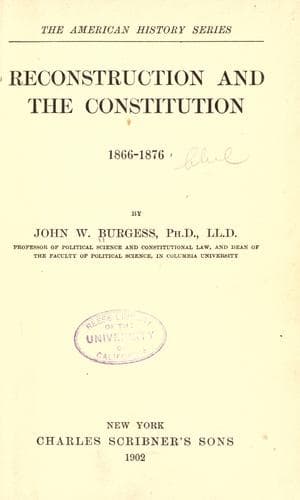
Reconstruction and the Constitution, 1866-1876Burgess, John William
History
Reconstruction and the Constitution, 1866-1876
Burgess, John William
Reconstruction (U.S. history, 1865-1877); United States -- Politics and government -- 1865-1877
The fact is that Mr. Stanton and those who abetted him were the
violators of law. Every official act which he committed after receiving
the notification from the President of his removal, on the 21st of
February, was a usurpation of governmental powers by a private citizen,
and the gathering of armed men about him with the purpose of sustaining
him in holding on to the War Office after his dismissal by the
President was treason. It is a question whether his official acts after
the 13th of January and down to February 21st were not also
usurpations. That depends upon whether the Tenure-of-Office Act was, or
was not, constitutional, and whether, if it were, the right of a member
of the Cabinet, suspended from office, to resume the functions of the
office, after disapproval of the suspension by the Senate, was made, by
the Act, to apply to such members of the Cabinet as were excepted from
the operation of the first article of the Act by the proviso to that
article. The best Republican lawyers in the Senate, Trumbull,
Fessenden, Grimes and Doolittle, took the view of the law in the
President's case as here explained. They, with one other Republican,
Van Winkle of West Virginia, filed, after the vote on impeachment,
opinions in the case expressing substantially this view.
[Sidenote: The nomination of General Schofield to be Secretary of War.]
It is now known that during the trial some of these men expressed to
one of the President's counsel the belief that Mr. Johnson could not be
convicted upon the law and evidence in the case, and that should the
Senate vote to remove him, "it would be done wholly from supposed party
necessity," and from fear of what the President might do in case he
were acquitted, and that they suggested to this member of the
President's counsel the wisdom of the President's sending to the
Senate, at that {190} juncture, a nomination for the Secretaryship of
War, which would allay all reasonable apprehension that the President
would, if acquitted, use the War Department for the accomplishment of
any arbitrary purposes, and that they mentioned General Schofield as a
man who would be satisfactory. These communications were made about the
20th of April. The President was immediately informed of them, as was
General Schofield, and, on April 24th, the President nominated General
Schofield to the Senate to be Secretary of War. Whether this move on
the part of the President influenced any Senator to vote for acquittal
is unknown. It certainly served to allay popular apprehension, if the
testimony of the newspapers of the day may be taken on that point.
[Sidenote: The vote upon impeachment.]
Public-domain text, read in full here on John Shaqi.
Reviews
Reviews
No reviews yet
Be the first to share your thoughts on this work.
Elsewhere in the archive
Join the Discussion
Join the discussion
Sign in to leave a comment or review.
Sign InorCreate an account