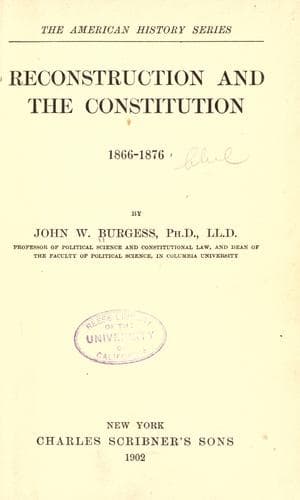
Reconstruction and the Constitution, 1866-1876Burgess, John William
History
Reconstruction and the Constitution, 1866-1876
Burgess, John William
Reconstruction (U.S. history, 1865-1877); United States -- Politics and government -- 1865-1877
Some of Stanton's friends have tried to make out that but for Stanton's
resistance and the impeachment, and its nearness to success, Johnson
would have appointed a tool of his own to the War Office and have rode
rough-shod over the laws of the land, and that he was frightened out of
this purpose, and frightened into an implied agreement with certain
Senators and General Schofield that the Reconstruction laws should be
executed as Stanton understood them, and not as the President
understood them. There is little ground for {193} any such assumptions.
There is certainly none in the character of the men whom the President
asked to take the War Office, Grant, Sherman and Ewing; and it must be
remembered that through Mr. Stanbery, in the case of Mississippi vs.
Johnson, he had long before announced to the Southerners that his
opposition to the Reconstruction Acts ceased with his unsuccessful veto
of them, and that he should execute them both in letter and in spirit.
It was Republican Senators who suggested to the President's counsel the
nomination of General Schofield, a man entirely friendly with the
President and acceptable to him. Neither the President nor the
President's counsel approached any Senator with the proposition. It was
the Republican Senators who were frightened, rather than the President
or his counsel. These Senators knew that the law and the evidence were
with the President, and that the Republican party was on trial, as much
so as the President; and they knew that, if the Republican Senate
should, upon the showing made by the President's counsel of the law and
the evidence in the case, convict the President and remove him from
office, the party would stand arraigned before the people for having
destroyed the constitutional balance between the executive and the
legislature in order to gain a partisan end. They recognized the
dilemma into which the hot-headed leaders of the party in the House of
Representatives had, by their hasty impeachment procedure, brought the
party, and they were very much relieved to secure any understanding
with the President's counsel whereby the chance of averting the
catastrophe to the party, as well as to the country, might be
increased. The suspicion that Mr. Stanton was playing his part for the
purpose of securing the Republican nomination for the presidency in
1868, rather than from any motives of disinterested {194} patriotism,
has about as little foundation as has the theory of salutary terror,
produced by the impeachment, controlling the President's subsequent
actions against his own preconceived plans and purposes. Both of these
speculations are no valid parts of the history of this great
transaction. What we have as certain facts are that the judgment was an
acquittal, that it was rendered in accordance with law and evidence,
and that it preserved the constitutional balance between the executive
and the legislature in the governmental system of the country; and that
Public-domain text, read in full here on John Shaqi.
Reviews
Reviews
No reviews yet
Be the first to share your thoughts on this work.
Elsewhere in the archive
Join the Discussion
Join the discussion
Sign in to leave a comment or review.
Sign InorCreate an account