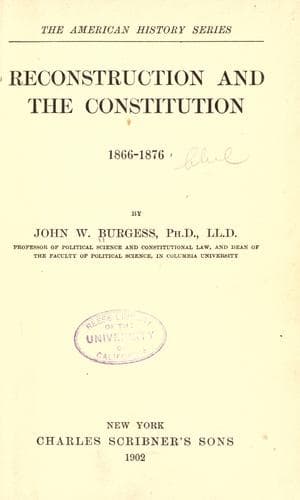
Reconstruction and the Constitution, 1866-1876Burgess, John William
History
Reconstruction and the Constitution, 1866-1876
Burgess, John William
Reconstruction (U.S. history, 1865-1877); United States -- Politics and government -- 1865-1877
for this the judgment of history coincides with the judgment of the
court.
{195}
CHAPTER X
RECONSTRUCTION RESUMED
The McCardle Case--The Congressional Acts Admitting the Senators- and
Representatives-elect from the Reconstructed "States" to Seats in
Congress--The Veto of these Bills by the President--The Vetoes
Overridden--Ratification of the Fourteenth Amendment and the
President's Proclamations Declaring Reconstruction Completed--Seward's
Proclamation Declaring the Ratification of the Fourteenth Amendment by
the Required Number of "States"--The Questions Suggested by Mr.
Seward's First Proclamation--The Concurrent Resolution of Congress upon
these Questions--The Correct Procedure--The National Conventions of
1868--Platform and Nominees of the Republican Party--Democratic
Platform and Nominees--The Election and the Electoral Vote--The Conduct
of the President during the Campaign--Congress and the President--The
President's Last Annual Message--The President's Amnesty Proclamation
of December 25th, 1868--The President's Veto of the Bill in Regard to
the Colored Schools in the District of Columbia--The Fifteenth
Amendment--Criticism of the Republican View--Johnson's Retirement from
the Presidency--The President and the Republican Party.
[Sidenote: The McCardle case.]
During the period of the impeachment trial, a case was in progress
before the Supreme Court of the United States, which in its final
settlement was destined to deprive the President of any hope that a
judicial decision in regard to the constitutionality of the
Reconstruction Acts could ever be attained. We have seen that in the
cases of Mississippi vs. Johnson and of Georgia vs. Stanton the
President had resisted the jurisdiction of the Court when {196} aimed
directly at the Executive and his immediate agents. This was his duty,
and he performed it sincerely and successfully. But it is not to be
inferred from this that he would not have welcomed a judicial decision
from the Supreme Court of the United States pronouncing these Acts null
and void, if it could have been reached through the forms of a proper
case, one not involving the executive authority at all.
Public-domain text, read in full here on John Shaqi.
Reviews
Reviews
No reviews yet
Be the first to share your thoughts on this work.
Elsewhere in the archive
Join the Discussion
Join the discussion
Sign in to leave a comment or review.
Sign InorCreate an account