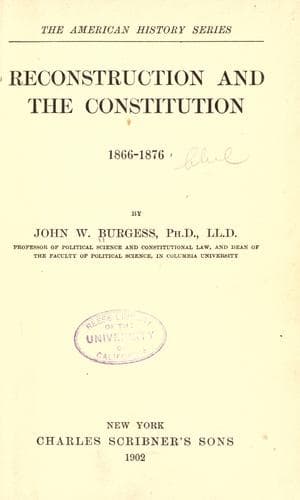
Reconstruction and the Constitution, 1866-1876Burgess, John William
History
Reconstruction and the Constitution, 1866-1876
Burgess, John William
Reconstruction (U.S. history, 1865-1877); United States -- Politics and government -- 1865-1877
Such of the legislatures created under the new "State" constitutions as
were not already in session were quickly summoned to assemble, and by
July 21st all of them had ratified the proposed Fourteenth Amendment to
the Constitution of the United States, and the legislature of Georgia
had also pledged by solemn act that the repudiation article of the new
constitution should never be enforced. By July 27th the President had
issued his several proclamations, as required by the Act of June 25th,
announcing the ratification of the proposed Fourteenth Amendment by
these legislatures, and consequently the admission of these "States" to
representation in Congress; and so far as the seven "States" of
Arkansas, North Carolina, South Carolina, Georgia, Alabama, Florida and
Louisiana were concerned the work of reconstruction was now completed.
Virginia, Mississippi and Texas still remained under martial law.
[Sidenote: Seward's proclamation declaring the ratification of the
Fourteenth Amendment by the required number of "States."]
On the 28th day of July, Mr. Seward, the Secretary of State, issued his
proclamation, declaring the ratification of the proposed Fourteenth
Amendment to the Constitution of the United States by the legislatures
of thirty States of the Union, and its consequent validity as a part of
the Constitution of the United States.
{203} [Sidenote: The questions suggested by Mr. Seward's first
proclamation.]
Eight days before this proclamation, that is on the 20th, Mr. Seward
had issued a proclamation declaring that the legislatures of
twenty-three States, viz., of Connecticut, New Hampshire, Tennessee,
New Jersey, Oregon, Vermont, New York, Ohio, Illinois, West Virginia,
Kansas, Maine, Nevada, Missouri, Indiana, Minnesota, Rhode Island,
Wisconsin, Pennsylvania, Michigan, Massachusetts, Nebraska and Iowa,
had ratified the proposed Fourteenth Amendment, and that six
"newly-constituted and newly-established bodies avowing themselves to
be, and acting as, the legislatures, respectively, of the States of
Arkansas, Florida, North Carolina, Louisiana, South Carolina, and
Alabama" had also ratified it; that the legislatures of Ohio and New
Jersey had subsequently passed resolutions withdrawing their
ratification of the Amendment; and that, if these latter resolutions of
the legislatures of Ohio and New Jersey should be disregarded, the
proposed Fourteenth Amendment had been adopted by the legislatures of
twenty-nine of the thirty-seven "States" of the Union and had thus
become a valid part of the Constitution of the United States.
Public-domain text, read in full here on John Shaqi.
Reviews
Reviews
No reviews yet
Be the first to share your thoughts on this work.
Elsewhere in the archive
Join the Discussion
Join the discussion
Sign in to leave a comment or review.
Sign InorCreate an account