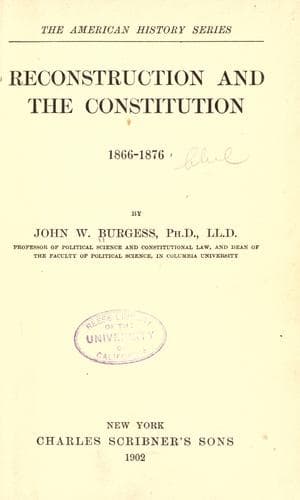
Reconstruction and the Constitution, 1866-1876Burgess, John William
History
Reconstruction and the Constitution, 1866-1876
Burgess, John William
Reconstruction (U.S. history, 1865-1877); United States -- Politics and government -- 1865-1877
Besides the question expressed in this Proclamation, Mr. Seward
indicates by his language a further question, viz., whether the six
"newly-constituted and newly-established bodies, avowing themselves to
be, and acting as, the legislatures, respectively, of the States of
Arkansas, Florida, North Carolina, Louisiana, South Carolina, and
Alabama" were genuine "State" legislatures. They were the legislatures
established under the Reconstruction Acts of Congress, but as Congress
had refused to recognize the "States" for whom these bodies acted as
entitled to representation in Congress, that is as "States" having the
rights of "States" of the Union, until {204} after these bodies had
ratified the proposed Fourteenth Amendment to the Constitution of the
United States, it was no wonder that so good a constitutional lawyer
and so logical a thinker as Mr. Seward had his doubts as to whether
these bodies were genuine "State" legislatures.
[Sidenote: The concurrent resolution of Congress upon these questions.]
In order to quiet these doubts, if possible, the two Houses of Congress
passed on the following day, July 21st, the following concurrent
resolution: "Whereas the legislatures of the States of Connecticut,
Tennessee, _New Jersey_, Oregon, Vermont, West Virginia, Kansas,
Missouri, Indiana, _Ohio_, Illinois, Minnesota, New York, Wisconsin,
Pennsylvania, Rhode Island, Michigan, Nevada, New Hampshire,
Massachusetts, Nebraska, Maine, Iowa, _Arkansas_, _Florida_, _North
Carolina_, _Alabama_, _South Carolina_ and _Louisiana_, being
three-fourths and more of the several States of the Union, have
ratified the Fourteenth Article of Amendment to the Constitution of the
United States, duly proposed by two-thirds of each House of the
Thirty-ninth Congress; therefore, Resolved by the Senate (the House of
Representatives concurring), That said Fourteenth Article is hereby
declared to be a part of the Constitution of the United States, and it
shall be duly promulgated as such by the Secretary of State." Upon the
basis of this resolution, which decided, in so far as Congress can
decide, that the consent of the legislature of a "State" to a proposed
amendment to the Constitution of the United States cannot be withdrawn
when once given, and that the "newly-constituted and newly-established
bodies, avowing themselves to be, and acting as, the legislatures,
respectively, of the States of Arkansas, Florida, North Carolina,
Louisiana, South Carolina, and Alabama" were genuine "State"
legislatures qualified to {205} vote upon the ratification of a
proposed amendment to the Constitution of the United States, Mr. Seward
issued his proclamation of the 28th of July, above recited. As the
Georgia Legislature ratified the proposed amendment on the 21st inst.
and also gave its pledge not to allow the repudiation article in its
constitution to be enforced, Mr. Seward included Georgia in this last
proclamation.
Public-domain text, read in full here on John Shaqi.
Reviews
Reviews
No reviews yet
Be the first to share your thoughts on this work.
Elsewhere in the archive
Join the Discussion
Join the discussion
Sign in to leave a comment or review.
Sign InorCreate an account