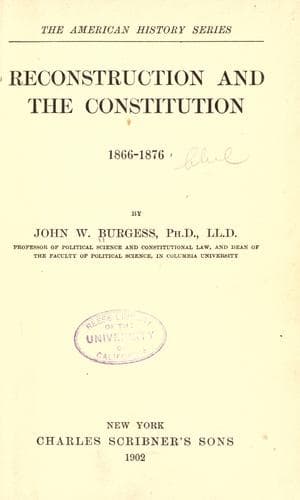
Reconstruction and the Constitution, 1866-1876Burgess, John William
History
Reconstruction and the Constitution, 1866-1876
Burgess, John William
Reconstruction (U.S. history, 1865-1877); United States -- Politics and government -- 1865-1877
In pronouncing for the guaranty of negro suffrage at the South by
Congressional law, the platform attempted to steer clear of the
prejudices against negro suffrage at the North by a sort of proviso,
which read, "While the question of suffrage in all the loyal States
properly belongs to the people of those States." This was certainly
inconsistent, not to say hypocritical. Negro suffrage at the North
would have been a comparatively harmless thing on account of the
fewness of the negroes as compared with the whites in that section, and
on account of the superior average intelligence of the negroes of the
North when compared with that of those of the South. There was no sound
principle in this article of the platform. It was a mean, shuffling bit
of partisan politics. The party itself felt it to be so in the course
of the campaign, and came out finally for the settlement of the whole
question of negro suffrage upon the same basis for the whole country
and by means of a constitutional amendment.
{208} The nominees immediately accepted their nominations in
characteristic letters, that of General Grant being short, crisp,
modest and ending with the now famous sentence: "Let us have peace,"
and that of Colfax being more lengthy and wordy and containing a
rhetorical defence of some of the more questionable parts of the
platform.
[Sidenote: Democratic platform and nominees.]
The Democratic convention assembled in New York on the 4th day of July.
It was confronted at the start with the Greenback heresy, and the
candidacy of the Greenback champion for the presidency, Mr. George H.
Pendleton of Ohio. This heresy was in a sentence the doctrine that all
the public debt of the United States not made expressly payable in coin
should be paid in United States paper, which Congress might order to be
stamped, issued, and made legal tender, to any amount it might please.
The shibboleth was, "the same currency for the bondholder and the
plough-holder." It had taken firm hold in Ohio, and was rapidly
spreading through the valley of the Mississippi. The Eastern Democrats,
however, looked upon it with disfavor, and were determined to defeat
the nomination of Mr. Pendleton. They were obliged, however, to accept
the platform, in so far as it related to this subject, as dictated by
their Western compatriots. The third plank in the platform read, "...
and where the obligations of the Government do not expressly state upon
their face, or the law under which they were issued does not provide,
that they shall be paid in coin, they ought in right and in justice to
be paid in the lawful money of the United States." The fifth plank also
read, "one currency for the Government and the people, the laborer and
the officeholder, the pensioner and the soldier, the producer and the
bondholder." It is true that the {209} platform did not expressly
pronounce in favor of an unlimited issue of paper money with which to
Public-domain text, read in full here on John Shaqi.
Reviews
Reviews
No reviews yet
Be the first to share your thoughts on this work.
Elsewhere in the archive
Join the Discussion
Join the discussion
Sign in to leave a comment or review.
Sign InorCreate an account