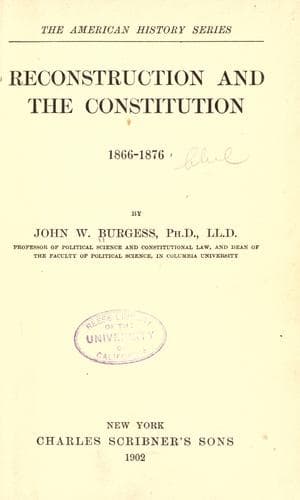
Reconstruction and the Constitution, 1866-1876Burgess, John William
History
Reconstruction and the Constitution, 1866-1876
Burgess, John William
Reconstruction (U.S. history, 1865-1877); United States -- Politics and government -- 1865-1877
pay the bonds, but it was generally understood that this was what was
meant. The questions then of sound money and of the faithful discharge
of the public obligations were thus put in issue. The Democrats also
met squarely the Republican doctrine of Reconstruction. They demanded
the "immediate restoration of all the States to their rights in the
Union under the Constitution, and of civil government to the American
people," with "amnesty for all past political offences, and the
regulation of the election franchise in the States by their citizens."
And they denounced the Radical party, as they termed the Republicans,
"for its disregard of right, and the unparalleled oppression and
tyranny which have marked its career," declared the Reconstruction Acts
to be unconstitutional, revolutionary and void, and lauded President
Johnson for his unflinching resistance to "the aggressions of Congress
upon the constitutional rights of the States and the people."
[Sidenote: Weakness of the platform.]
There is no question that the platform of the Democrats, with its paper
money doctrine, and its hostility to Reconstruction and universal
suffrage, was a shaky foundation for any party to attempt to stand upon
at that juncture. Not much conscience and not much sentiment could be
aroused with such tenets. Conscience and sentiment were much more
amenable to the appeals of the Republican platform upon these points.
Moreover, the tremendous popularity of the Republican candidates had to
be reckoned with. Where could the Democrats find a candidate who would
both match Grant in the popular affection and overbalance also the
weakness of the platform? The New Yorkers in the convention, led by
Seymour, Tilden, Schell and Kernan, {210} had their man for this
emergency, but they dared not reveal at the outset their plan. They
were resolved to nominate Chief Justice Chase. They thought that
Chase's well-known devotion to the principles of universal suffrage and
his career as Secretary of the Treasury would satisfy the Eastern men
in regard to the platform, and that his attachment to the principles of
civil government versus militarism would, in some degree at least,
neutralize the popularity of the military hero. The delegates from
Ohio, Mr. Chase's own "State," suspected the purpose of the New
Yorkers, and were determined to foil it. If they could not get
Pendleton, they were determined not to have Chase. After the first six
ballots without result, Pendleton, however, leading, the New Yorkers
brought forward Hendricks of Indiana, in order to break down
Pendleton's vote. Having succeeded in this after some six more ballots,
the name of Chase was brought before the convention by a half vote from
California. The purpose was probably to feel of the convention. It was
highly successful. The announcement of the half vote was received with
enthusiastic applause. Masking themselves behind Hancock, who was at
that juncture in the lead, and Hendricks, the New Yorkers now prepared
Public-domain text, read in full here on John Shaqi.
Reviews
Reviews
No reviews yet
Be the first to share your thoughts on this work.
Elsewhere in the archive
Join the Discussion
Join the discussion
Sign in to leave a comment or review.
Sign InorCreate an account